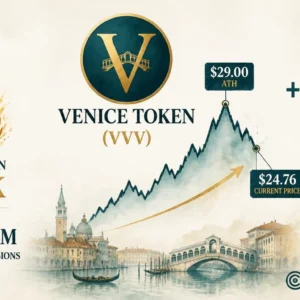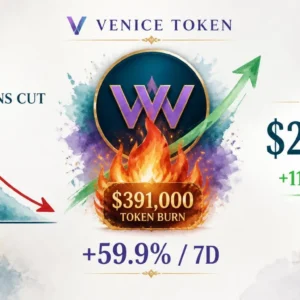


- VVV trades at $25.86 — up 48.5% in 7 days and 7.47% in 24 hours — with a $1.239B market cap per CoinGecko
- Record $391,000 VVV token burn executed Sept. 9; annual emissions cut to 2.0M VVV — supply tightening confirmed
- NEAR Protocol partnership (Sept. 8) enables confidential VVV swaps and staking on NEAR AI Cloud
- Kalshi listed VVV perpetual futures Sept. 4 — first CFTC-regulated derivatives access for the token
Venice Token’s 48.5% seven-day rally is traceable to three simultaneous, verifiable events: a record-breaking token burn on September 9, a NEAR Protocol partnership announced September 8, and the listing of VVV perpetual futures on a CFTC-regulated venue on September 4. This is not a momentum story — it is a supply-side and access story arriving in tight sequence.
At the time of writing, VVV is trading at approximately $25.86, up 7.47% in the past 24 hours and 2.60% in the past hour. The token’s market capitalization stands at $1.239 billion, according to CoinGecko data as of September 11, 2026.
Catalyst 1 — Record $391,000 Token Burn Tightens Supply
On September 9, 2026, Venice Protocol executed what has been reported as the largest single VVV token burn to date, removing tokens valued at approximately $391,000 from circulation. This event did not arrive in isolation — it followed two successive reductions in annual emissions, first from a prior baseline to 2.5 million VVV, then further reduced to 2.0 million VVV per year.
The mechanism is straightforward: fewer tokens entering circulation while existing supply is permanently destroyed reduces the float available to the market. When demand is steady or rising, a compressed supply base amplifies price sensitivity to any incremental buying. The burn and emissions cuts together represent a deliberate tightening of VVV’s monetary policy — a structural shift, not a one-time event.
Why Token Burns Flow Directly to VVV Price
Each burn permanently reduces the total supply of VVV. Combined with lower annual emissions, the protocol is slowing the rate at which new tokens reach the market while simultaneously destroying existing ones. For investors, this creates a supply trajectory that is contracting rather than expanding — a meaningful distinction in an asset class where inflation schedules frequently dilute holders.
For additional context on VVV’s prior price behavior around tokenomics data, see this earlier CoinsProbe analysis: Venice Token (VVV) Holds $24.40 While BTR Drops 24.7% — What the Data Says.
Catalyst 2 — NEAR Protocol Partnership Expands Utility
On September 8, 2026 — one day before the record burn — Venice announced a partnership with NEAR Protocol covering confidential VVV swaps and staking, with Venice’s privacy encryption layer running on NEAR AI Cloud. The partnership directly expands the functional scope of VVV: staking on a second major chain creates new demand for the token without increasing supply.
The privacy-AI angle matters here. Venice’s core product is a private AI inference platform — users interact with AI models without their data being logged or used for training. NEAR AI Cloud provides the infrastructure layer. The partnership, therefore, is not a marketing announcement; it is a deployment of Venice’s core technology on a new network, with VVV as the required staking asset for participation.
Catalyst 3 — Kalshi Lists VVV Perpetual Futures
On September 4, 2026, Kalshi — a CFTC-regulated prediction and derivatives market — listed VVV perpetual futures. This is a meaningful structural event for a token of VVV’s size. A listing on a regulated derivatives venue does two things simultaneously: it increases the addressable pool of capital that can gain exposure to VVV (including participants who are restricted to regulated venues), and it introduces leveraged speculation that can amplify price moves in either direction.
On-chain data cited by market monitors showed at least one large holder taking profit and routing a portion of VVV holdings to Coinbase during the rally week — consistent with sophisticated participants managing positions in response to the liquidity improvement the Kalshi listing provided.
| Date | Event | Impact |
|---|---|---|
| Sept. 4, 2026 | Kalshi VVV perp futures listing | Regulated derivatives access opened |
| Sept. 8, 2026 | NEAR Protocol partnership announced | Confidential swaps + staking on NEAR AI Cloud |
| Sept. 9, 2026 | $391,000 record token burn executed | Single largest burn; annual emissions cut to 2M VVV |
Key VVV catalyst timeline, September 2026 | Source: CoinGecko, web research
Is the Rally Sustainable?
The three catalysts that drove this week’s move are now priced in to varying degrees. The Kalshi listing and NEAR partnership are known quantities — the market has had days to absorb both. The token burn is more durable as a signal: if Venice continues executing burns at this pace and maintains the 2.0 million VVV annual emission ceiling, the supply trajectory supports higher prices structurally. The metric to track is Venice’s on-chain burn frequency and the annualized emission rate relative to platform revenue — data points that can be monitored via Venice’s own dashboard and on-chain explorers.
The risk to sustainability is normalization: if platform usage does not grow into the AI-privacy narrative, the tokenomics tightening alone cannot sustain a $1.24 billion market cap indefinitely. Broader AI and privacy-token sentiment, which appeared to amplify this week’s move rather than cause it, could reverse equally quickly. Watch whether the NEAR partnership drives measurable staking inflows — that would be the clearest sign that the utility expansion is converting to real demand.
For the full prior breakdown of VVV’s weekly driver context, see: Why Is Venice Token (VVV) Up 48.3% in 7 Days? The Key Catalysts Explained.
Venice Token’s 48.5% weekly move resolves to three verified events arriving within a six-day window: Kalshi’s regulated futures listing on September 4, the NEAR Protocol confidential-staking partnership on September 8, and a $391,000 record token burn on September 9 — against a backdrop of annual emissions already cut to 2.0 million VVV. The supply is contracting, the utility is expanding, and regulated capital now has direct access. The metric to track going forward is Venice’s on-chain burn cadence and whether NEAR staking inflows materialize — that data will determine whether the $1.24 billion market cap holds.
Source: coingecko.comFrequently Asked Questions
Why is Venice Token (VVV) surging this week?
What was Venice Token’s record token burn?
What is the NEAR Protocol partnership with Venice Token?
Is Venice Token’s rally sustainable at a $1.24 billion market cap?
Source: CoinGecko Markets · Published by CoinsProbe Markets Desk
The opinions and market insights shared on CoinsProbe represent the views of individual authors based on prevailing market conditions at the time of publication. Cryptocurrency investments carry significant risk and volatility. Readers are encouraged to conduct their own research and seek professional financial advice before making investment decisions. CoinsProbe and its contributors do not accept responsibility for financial losses or decisions made based on published content.
CoinsProbe may publish sponsored articles, affiliate links, or promotional collaborations. All sponsored material is clearly labeled to maintain transparency with our audience. Our editorial decisions remain fully independent, and advertising partnerships do not influence reviews, rankings, or published opinions.
Since 2023, CoinsProbe has delivered reliable insights on cryptocurrency, blockchain, and digital assets. Our content is created by experienced researchers and analysts who follow strict editorial standards focused on accuracy, transparency, and credibility. Every article is carefully reviewed and verified using trusted sources and current market data. We provide unbiased analysis and timely updates covering everything from emerging crypto projects to major industry developments.