
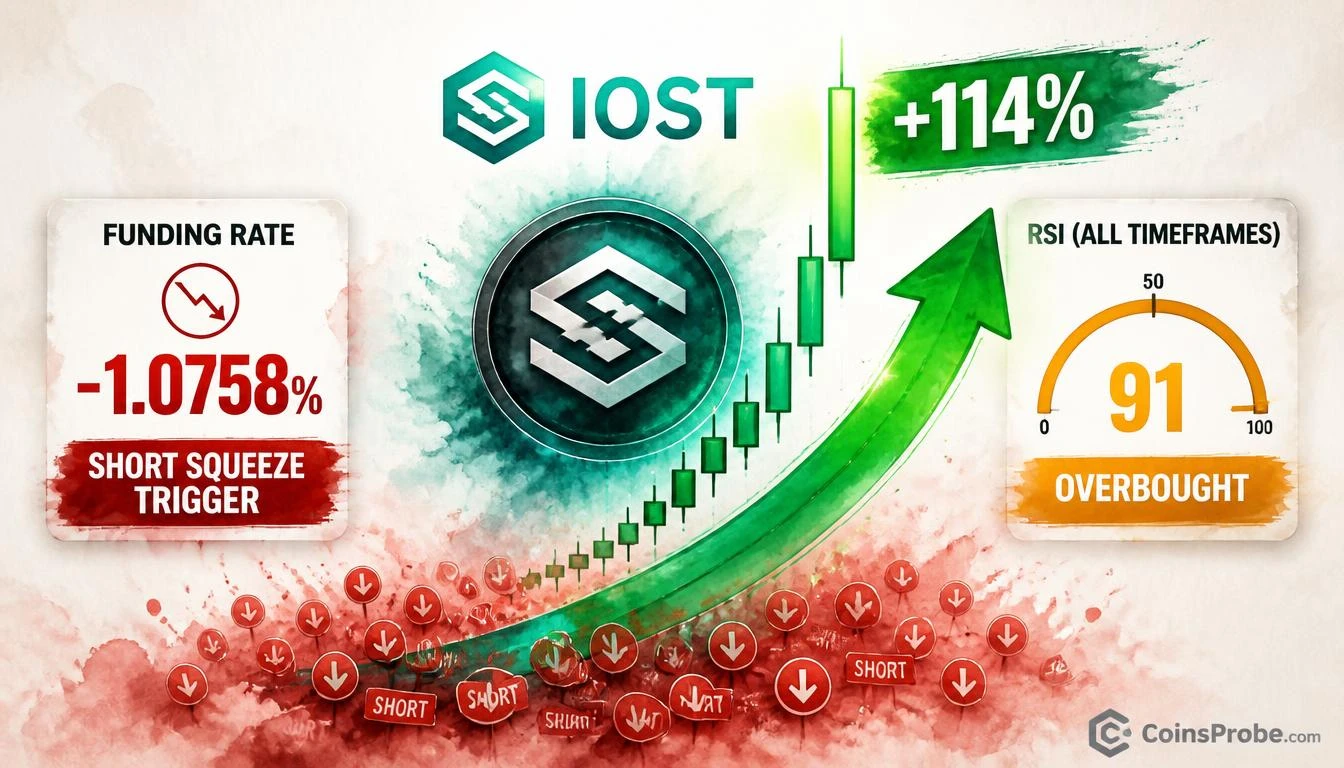
- IOST surges +114.44% in 24 hours and +8.38% in the past hour — currently trading at $0.001967 per Coinglass
- Funding rate hit -1.0758% before the move — one of the most extreme short-crowding signals in the current altcoin market
- $5.55M in 24-hour liquidations and $1.29B in volume confirm short squeeze mechanics, not organic demand
- RSI reads 90.79 / 88.11 / 91.38 across 1h, 4h, and daily — multi-timeframe exhaustion signal per Coinglass
BREAKING
IOST’s 114.44% single-day surge is not driven by a protocol upgrade or a new partnership announcement. The Coinglass data tells a specific structural story: an extreme negative funding rate combined with a sudden price reversal forced short-sellers to cover en masse — the textbook definition of a short squeeze.
At the time of writing, IOST is trading at approximately $0.001967, up 8.38% in the past hour and 114.44% over the past 24 hours. Market capitalization sits at $67.11M with $1.29B in 24-hour trading volume — a volume figure that dwarfs the asset’s entire market cap by roughly 19x, a hallmark of squeeze-driven activity per Coinglass.
The Primary Catalyst — Extreme Negative Funding Rate Triggering a Short Squeeze
Before the move, IOST carried a funding rate of -1.0758% — one of the most deeply negative readings in the derivatives market. To understand why this matters, a brief explanation of funding mechanics is necessary.
In perpetual futures markets, funding rates are periodic payments exchanged between long and short positions. A negative funding rate means short-sellers are paying longs to hold their positions — it reflects a market crowded with traders betting on downside. When funding goes this deeply negative, it signals that short positioning has become structurally overcrowded.
The consequence is predictable: any upward price movement forces short-sellers to either pay mounting funding costs or close their positions by buying the asset. That buying pressure amplifies the price move, which forces more shorts to close, which creates more buying — a self-reinforcing loop.
| Metric | Value |
|---|---|
| Price (24h ago, approx.) | ~$0.000920 |
| Current Price | $0.001967 |
| 24h Price Change | +114.44% |
| 1h Price Change | +8.38% |
| Funding Rate | -1.0758% |
| Open Interest | $70.83M |
| 24h Volume | $1.29B |
| 24h Liquidations | $5.55M |
| RSI (1h / 4h / 1D) | 90.79 / 88.11 / 91.38 |
Source: Coinglass — September 9, 2026
Why Negative Funding Flows Directly Into a Price Explosion
A funding rate of -1.0758% is not a mild bearish lean — it represents one of the most extreme short-crowding conditions a perpetual futures market can sustain. At this level, short-sellers were paying over 1% per funding interval simply to maintain their positions. When IOST began moving upward — for whatever initial reason — the cascade was structural, not speculative. Coinglass recorded $5.55M in liquidations over 24 hours, consistent with forced short closures amplifying the initial move. The interpretation from Coinglass’s own data flags this as a scenario where “a downside move caught short-sellers off guard” — which in this case inverted: the upside move caught the overcrowded short side off guard instead.
RSI Readings Confirm Momentum Exhaustion Risk
With RSI readings of 90.79 on the 1-hour, 88.11 on the 4-hour, and 91.38 on the daily, IOST is now printing one of the most overbought multi-timeframe RSI configurations visible in the current market. RSI above 70 is conventionally overbought; readings above 90 across all three timeframes simultaneously indicate momentum that has moved far beyond sustainable buying pressure into exhaustion territory.
This does not predict a reversal — RSI can remain elevated during sustained squeezes — but it does signal that the fuel driving the move is derivative-market mechanics, not organic demand accumulation. For context, the broader market backdrop shows Bitcoin’s daily RSI at 60.47 and the Fear & Greed Index at 67/100, indicating a moderately risk-on environment — not an altcoin season (Altcoin Season Index: 48/100) — which means IOST’s move is isolated, not part of a broad rotation. This kind of single-asset squeeze dynamic is similar in structure to what drove Raydium’s 18.6% single-day surge earlier this cycle, though IOST’s magnitude is an order of magnitude larger due to the derivatives crowding factor.
Is the IOST Rally Sustainable?
The honest answer from the data: probably not at this velocity. A 114% move driven by short liquidation mechanics is, by definition, a mean-reversion event — it corrects an overextended short position, not a fundamental undervaluation. Once the short overhang is cleared — evidenced by the funding rate returning toward neutral (0.00% to +0.01%) — the mechanical buying pressure disappears. What remains is whatever organic demand exists at the new price level, which for a $67.11M market cap asset with no announced protocol catalyst is unclear.
The metric to monitor is IOST’s funding rate on Coinglass in real time. If funding normalizes toward zero while open interest ($70.83M currently) drops significantly, the squeeze is exhausting. If open interest remains elevated with funding still deeply negative, a second leg remains structurally possible — though RSI readings at 91 across all timeframes make sustained upside mechanically difficult without consolidation first.
IOST’s 114.44% move in 24 hours is a derivatives market event, not a fundamental rerating. A funding rate of -1.0758% created one of the most overcrowded short structures visible in the current altcoin market — and when price reversed, $5.55M in forced liquidations amplified a $1.29B volume day against a $67.11M market cap. Watch the IOST funding rate on Coinglass: a return to neutral is the clearest signal that the squeeze fuel has burned through.
Frequently Asked Questions
Why is IOST up 114% today?
What does a -1.0758% funding rate mean for IOST?
Is IOST’s 114% rally sustainable?
How does IOST’s move compare to the broader altcoin market?
Source: Coinglass +1 More · Published by CoinsProbe Markets Desk
The opinions and market insights shared on CoinsProbe represent the views of individual authors based on prevailing market conditions at the time of publication. Cryptocurrency investments carry significant risk and volatility. Readers are encouraged to conduct their own research and seek professional financial advice before making investment decisions. CoinsProbe and its contributors do not accept responsibility for financial losses or decisions made based on published content.
CoinsProbe may publish sponsored articles, affiliate links, or promotional collaborations. All sponsored material is clearly labeled to maintain transparency with our audience. Our editorial decisions remain fully independent, and advertising partnerships do not influence reviews, rankings, or published opinions.
Since 2023, CoinsProbe has delivered reliable insights on cryptocurrency, blockchain, and digital assets. Our content is created by experienced researchers and analysts who follow strict editorial standards focused on accuracy, transparency, and credibility. Every article is carefully reviewed and verified using trusted sources and current market data. We provide unbiased analysis and timely updates covering everything from emerging crypto projects to major industry developments.