
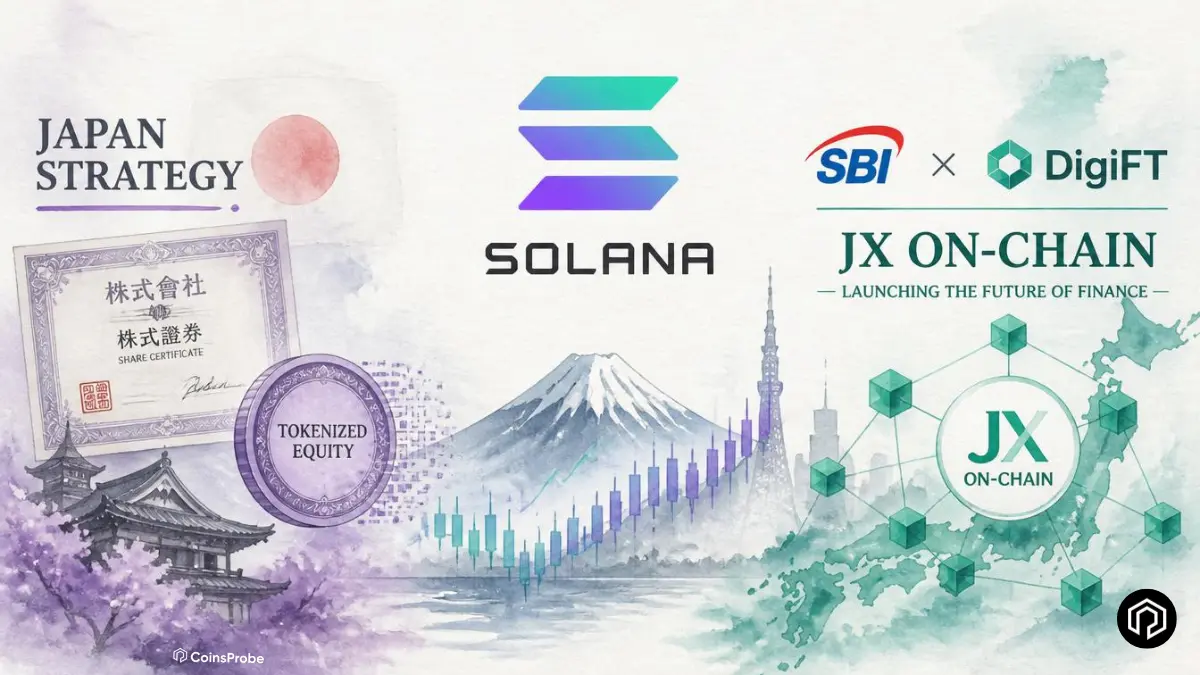

- SBI Global Asset Management and DigiFT have launched JX, the first tokenized Japanese listed equity strategy on the Solana blockchain.
- JX gives accredited and institutional investors regulated, on-chain exposure to a Japanese high-dividend equity strategy with direct ownership of the underlying assets.
- The launch comes as the tokenized RWA market surged from $5.9B to $21.9B in 2025, expanding beyond cash-like products into actively managed strategies.
- Meanwhile, analyst @alicharts says Solana's SuperTrend indicator has turned bullish, with potential upside targets of $96 and $121.
The tokenization of real-world assets has reached a new milestone — and this one comes from Japan. For the first time in the RWA sector’s history, a Japanese asset manager has brought one of its actively managed equity strategies directly on-chain, choosing Solana as the infrastructure and DigiFT as the regulated product wrapper to make it happen.
What Is JX?
JX (SBI Japan High Dividend Equity Strategy Token) is a tokenized investment product providing regulated, on-chain exposure to a Japanese high-dividend equity strategy managed by SBI Asset Management Co., Ltd. — a subsidiary of SBI Global Asset Management.
| Feature | Detail |
|---|---|
| Underlying strategy | Japanese high-dividend equity — actively managed |
| Exposure type | True ownership of the underlying strategy |
| Investor eligibility | Accredited and institutional investors only |
| Blockchain | Solana |
| Distributions | None at fund or token level (growth-type strategy) |
| Regulated infrastructure | DigiFT — MAS (Singapore) and SFC (Hong Kong) licensed |
True ownership — not synthetic exposure: This distinction matters significantly for institutional investors. JX does not use derivatives or financial engineering to replicate the performance of Japanese equities — it provides direct, regulated ownership of the underlying strategy itself. This is the same standard institutional investors apply to traditional fund investments, now delivered through on-chain infrastructure.
Regulated at both ends: DigiFT holds licences from the Monetary Authority of Singapore (MAS) and the Hong Kong Securities and Futures Commission (SFC) — two of Asia’s most rigorous financial regulatory bodies. This dual regulatory standing gives JX the institutional credibility that most RWA products still lack.
Why This Launch Is a Historic First
Henry Zhang, Founder and Group CEO of DigiFT, explained the significance of the launch:
“Our mission at DigiFT has always been to bring real, institutional-grade assets on-chain through infrastructure that investors and asset managers can actually trust. JX extends that mission to Japan for the first time, opening regulated, on-chain access to Japanese equities.”
The “for the first time” framing here is specific and meaningful — prior RWA tokenization has primarily focused on three categories: US Treasury bills and money market instruments, private credit products, and real estate. Actively managed public equity strategies from major national asset managers have largely remained outside the tokenization conversation until now.
JX changes that — not with a pilot programme or a proof-of-concept, but with a live, regulated product from a subsidiary of one of Japan’s largest financial conglomerates. This is the first genuinely institutional bridge between traditional Japanese equity markets and global digital asset infrastructure.
The timing is deliberate: The launch coincides with a period of genuine investor interest in Japanese equities — supported by the Tokyo Stock Exchange’s corporate governance reforms and capital efficiency improvements that have made Japanese equities one of the more compelling traditional market stories of the past two years.
The RWA Sector Context — From $5.9B to $21.9B in One Year
JX arrives at the most consequential moment in the RWA tokenization sector’s history. Global tokenized assets grew from $5.9 billion to $21.9 billion in 2025 — a +271% increase in a single year — as institutional adoption accelerated beyond the earliest infrastructure experiments.
The growth trajectory reflects a pattern we have been tracking throughout 2026: the shift from experimental pilot programmes to genuinely operational institutional products. Major institutions now active in the tokenized asset space include BNY Mellon, UBS, Invesco, and Franklin Templeton — names that signal the sector has crossed from crypto-native experimentation into mainstream financial services participation.
JX represents the next evolution of this trend: not just tokenizing cash-equivalent instruments or private credit, but bringing actively managed public market equity strategies on-chain for institutional access. This is the category that has the largest potential institutional addressable market — and SBI is the first Japanese asset manager to move there.
Why Solana — The Infrastructure Choice
Solana was chosen as the underlying blockchain for JX — a decision that reflects both the chain’s technical characteristics and its growing institutional credibility as an RWA platform.
The technical case for Solana:
Solana’s 100-millisecond block times, sub-cent transaction fees, and high throughput capacity make it the most practical public blockchain for financial products that require frequent settlement, redemption processing, and secondary market trading — the operational demands that matter most for institutional investors who need their infrastructure to function reliably at scale.
As Solana’s official announcement highlighted:
“BREAKING: SBI Global Asset Management and DigiFT have launched JX on Solana. For the first time, a Japanese asset manager’s equity strategy is live onchain.”
The JX launch reinforces Solana’s growing position as the preferred blockchain for institutional RWA tokenization — alongside other major institutions that have already tokenized products on the network. As we covered in our Solana Wyckoff Phase D and ETF momentum article — Solana’s institutional product adoption has been one of the most consistent fundamental narratives supporting SOL’s 2026 investment case, alongside the chain’s DeFi, memecoin, and developer ecosystem growth.
Solana’s Technical Outlook — SuperTrend Turns Bullish
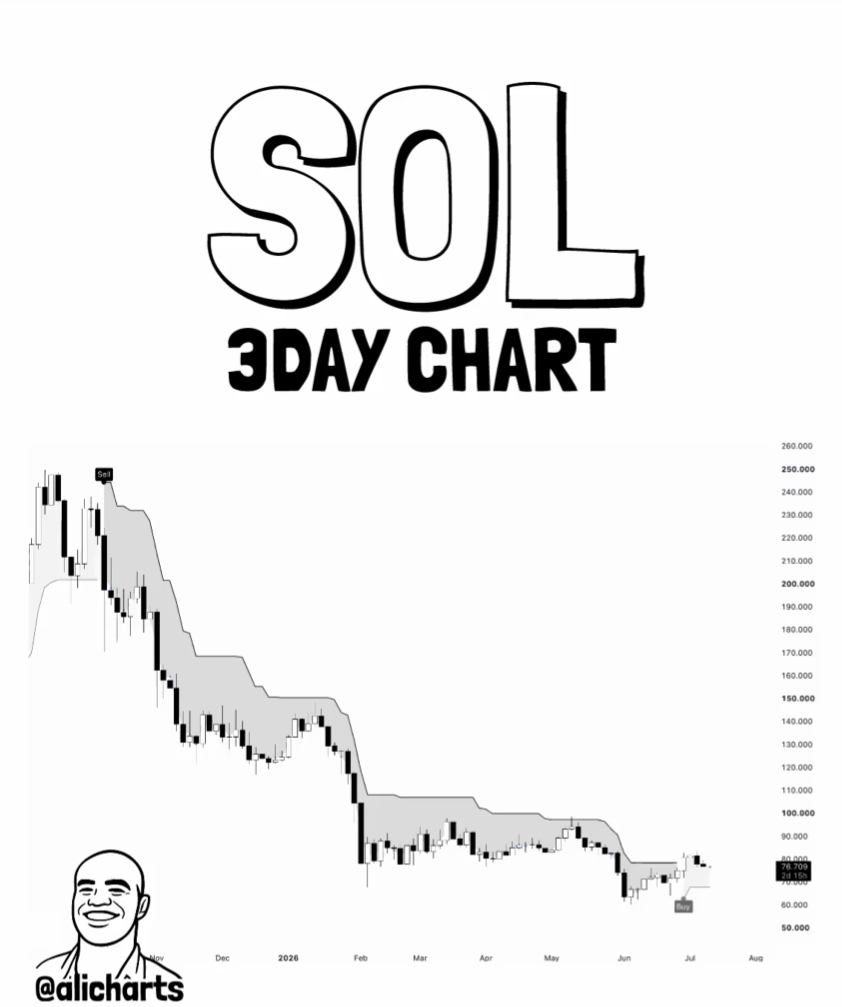
The JX launch arrives as Solana’s own price chart is showing a significant technical development. Analyst @alicharts flagged a bullish signal on the SOL chart:
“SOLANA TURNED BULLISH. The ATR trailing stop has flipped below price, marking the first SuperTrend buy signal since October 10. If buying pressure continues to build, $SOL could rally toward $96 or even $121. However, $60 remains the key level to watch.”
What the SuperTrend flip means:
The ATR (Average True Range) trailing stop has crossed below price — the technical definition of a SuperTrend bullish signal. This is the same class of indicator we covered when Ethereum’s SuperTrend flipped bullish on the 3-day chart — and the prior signals on both assets have historically preceded significant directional moves.
The key levels:
| Level | Significance |
|---|---|
| $121 | Extended upside target |
| $96 | Initial recovery target |
| Current price | ~$75 zone |
| $60 | Key support — must hold |
The first SuperTrend buy signal since October 10 — combined with an institutional RWA launch on Solana from a major Japanese asset manager — creates a genuinely interesting convergence of fundamental and technical momentum for SOL.
This technical development adds another layer to the broader Solana recovery thesis we have been building — as we covered in our SOL 2023 vs 2026 chart comparison article, Solana’s current price structure bears a striking resemblance to the 2023 bottoming pattern that preceded its historic recovery — and a SuperTrend bullish flip at this specific structural juncture strengthens rather than contradicts that parallel.
The Bigger Picture — What JX Signals for the RWA Sector
JX is not just a product launch — it is a proof of concept for a new category of institutional tokenized products. If a Japanese high-dividend equity strategy can be brought on-chain through a regulated wrapper on Solana, the logical extensions are significant:
European equity strategies. US large-cap funds. Asian fixed income. Multi-asset strategies from major global asset managers. Each of these becomes more viable as a tokenized product with every institutional precedent that is established.
The combination of MAS and SFC regulated infrastructure (DigiFT), a globally recognised Japanese financial brand (SBI), and the most institutionally adopted performance-focused public blockchain (Solana) provides the exact template that other asset managers globally will be watching closely as they evaluate their own tokenization timelines.
Bottom Line
The JX launch is a genuine milestone — the first actively managed Japanese equity strategy to go on-chain, delivered through regulated dual-licensed infrastructure, built on Solana, and backed by one of Japan’s largest financial conglomerates. In a sector that has spent years proving the concept with cash-equivalent instruments, JX represents the shift to the product category that institutional investors care most about: actively managed strategies with real equity exposure.
Simultaneously, Solana’s SuperTrend has just turned bullish for the first time since October — adding a technical signal to the fundamental narrative of a blockchain that is accumulating institutional product launches at an accelerating pace.
Frequently Asked Questions (FAQ)
What is JX?
JX (SBI Japan High Dividend Equity Strategy Token) is a tokenized product providing regulated, on-chain access to a Japanese high-dividend equity strategy managed by SBI Asset Management — built on Solana and distributed through DigiFT’s regulated infrastructure.
Why is the JX launch historically significant?
It is the first time a Japanese asset manager has tokenized one of its listed equity strategies and made it available on-chain — extending RWA tokenization beyond cash-equivalent instruments into actively managed public equity strategies.
Who can invest in JX?
JX is available exclusively to accredited and institutional investors — not retail participants — consistent with DigiFT’s regulated framework under MAS (Singapore) and SFC (Hong Kong) licences.
Why was Solana chosen for JX?
Solana’s 100-millisecond block times, sub-cent transaction fees, and high throughput make it the most practical public blockchain for institutional financial products requiring reliable, high-frequency settlement at scale.
How large is the global RWA tokenization market?
Global tokenized assets grew from $5.9 billion to $21.9 billion in 2025 — a +271% annual increase — as institutional adoption accelerated beyond pilot programmes into operational products.
The opinions and market insights shared on CoinsProbe represent the views of individual authors based on prevailing market conditions at the time of publication. Cryptocurrency investments carry significant risk and volatility. Readers are encouraged to conduct their own research and seek professional financial advice before making investment decisions. CoinsProbe and its contributors do not accept responsibility for financial losses or decisions made based on published content.
CoinsProbe may publish sponsored articles, affiliate links, or promotional collaborations. All sponsored material is clearly labeled to maintain transparency with our audience. Our editorial decisions remain fully independent, and advertising partnerships do not influence reviews, rankings, or published opinions.
Since 2023, CoinsProbe has delivered reliable insights on cryptocurrency, blockchain, and digital assets. Our content is created by experienced researchers and analysts who follow strict editorial standards focused on accuracy, transparency, and credibility. Every article is carefully reviewed and verified using trusted sources and current market data. We provide unbiased analysis and timely updates covering everything from emerging crypto projects to major industry developments.