
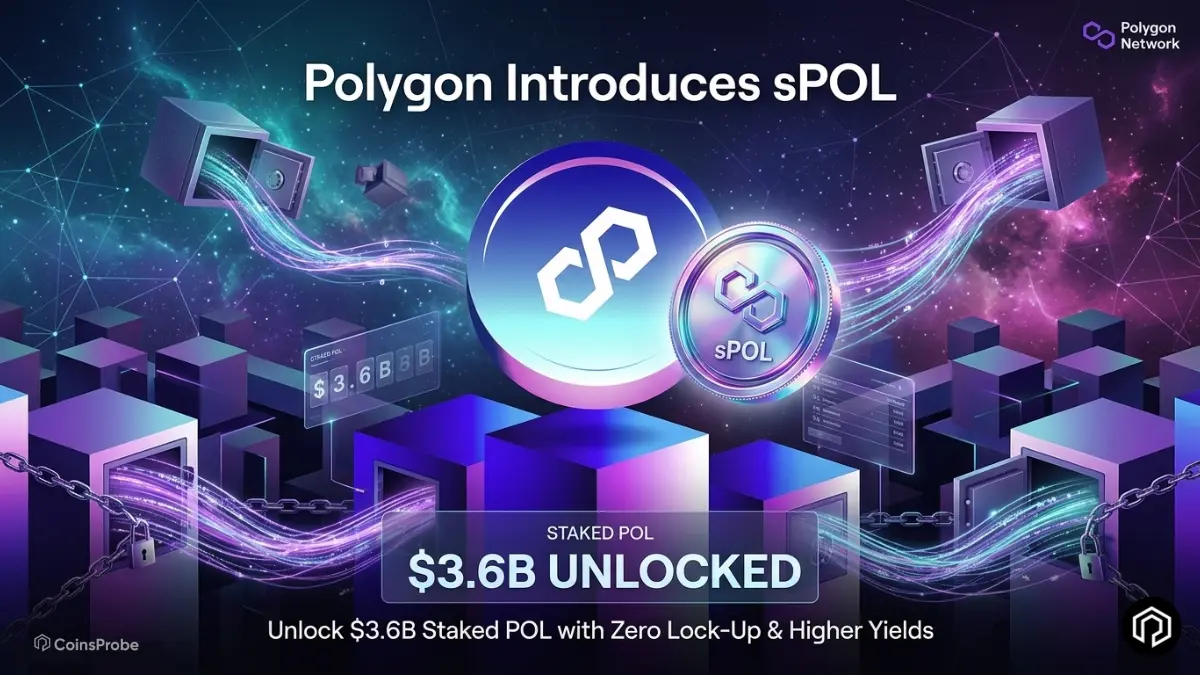
Polygon has officially unveiled sPOL — its first native liquid staking token (LST) — in a major move designed to supercharge staking participation, increase liquidity, and deliver real economic value back to POL stakers
.Announced today via the official @0xPolygon X account, sPOL directly addresses a long-standing pain point on the Polygon network: while over 3.6 billion POL are currently staked, only 4–5% of that capital is liquid and actively participating in DeFi. The rest sits idle, earning staking rewards but missing out on higher-yield opportunities.
What is sPOL?
sPOL is Polygon Labs’ own liquid staking token. It allows stakers to:
- Convert their staked POL into a liquid, tradable token (sPOL) 1:1 at launch.
- Continue earning staking rewards while using sPOL in DeFi protocols — providing liquidity, using it as collateral, or layering additional yield strategies.
- Redeem sPOL back to POL + accumulated rewards at any time through the Polygon staking portal with no waiting period.
Unlike third-party LSTs that have historically charged high fees (5–16% on Polygon), sPOL is built and backed directly by Polygon Labs. It is audited by ChainSecurity and Certora, and the team has committed $100 million in total treasury support:
- $10 million seeded on day one for liquidity.
- $90 million to be progressively added.
Uniswap V4 AMM pools for sPOL are live at launch, ensuring immediate liquidity without relying on market bootstrapping or external smart contracts.
A Game-Changer for Priority Fee Distributions
POL doesn’t just add liquidity — it fundamentally improves staking economics.
Polygon recently proposed changes to how priority transaction fees (tips paid by users for faster confirmations) are distributed. With sPOL, validators participating in the program agree to return a portion of these priority fees directly to sPOL delegators.
This means stakers now capture more of the value their capital helps generate on the network — a step toward true “staking alignment.” As Polygon’s activity and priority fees grow, sPOL holders stand to benefit significantly beyond traditional staking yields.
What changes with sPOL?
| Before sPOL (Normal Staking) | With sPOL (Liquid Staking) |
|---|---|
| POL is locked in staking | You get sPOL which you can trade or use in DeFi |
| You cannot use the tokens | You keep earning staking rewards automatically |
| Only ~4-5% of staked POL was usable | Now almost all 3.6 billion POL can become liquid |
| High fees on third-party solutions | Lower fees + backed by Polygon Labs |
In short:
sPOL unlocks the economic power of those 3.6 billion staked POL by turning the locked tokens into something you can freely use while still earning rewards.It’s like turning a fixed deposit that you can’t touch into a savings account where you can still spend the money if needed.
How sPOL Works (Simple & Seamless)
- New stakers: Deposit POL → Automatically receive sPOL (1:1 exchange rate).
- Existing stakers: Migrate your current validator position directly through the Polygon staking portal — no downtime, no gap in rewards.
- Value accrual: The sPOL/POL exchange rate increases over time as rewards compound. Your sPOL balance stays constant, but each token becomes worth more POL.
- Use it freely: Trade, lend, borrow, or provide liquidity in DeFi.
- Redeem anytime: Unstake via the portal to get your POL + rewards.
Why This Matters
On Ethereum, roughly 30% of staked ETH is in liquid staking tokens. On Polygon, that number has lagged at just 4–5%. The Polygon team believes the fragmented, high-fee third-party solutions were holding the ecosystem back.
sPOL aims to become the most composable staking primitive on Polygon — turning basic staking yield into a floor, not a ceiling. The real upside comes from what users build on top of sPOL in DeFi.
How to Stake?
- Visit the Polygon Staking Portal
- Stake or migrate your POL → Receive sPOL.
- Use it in DeFi or simply hold for enhanced staking rewards + priority fee share.
Official Announcement: View on X
Important Risk Disclaimers: POL is a staking product and carries risks including smart contract risk, validator slashing, and exchange-rate fluctuations. Staking rewards are not guaranteed and depend on network conditions and validator performance. While contracts have been audited, users should always do their own research. Full disclosures are available on the staking portal.
The opinions and market insights shared on CoinsProbe represent the views of individual authors based on prevailing market conditions at the time of publication. Cryptocurrency investments carry significant risk and volatility. Readers are encouraged to conduct their own research and seek professional financial advice before making investment decisions. CoinsProbe and its contributors do not accept responsibility for financial losses or decisions made based on published content.
CoinsProbe may publish sponsored articles, affiliate links, or promotional collaborations. All sponsored material is clearly labeled to maintain transparency with our audience. Our editorial decisions remain fully independent, and advertising partnerships do not influence reviews, rankings, or published opinions.
Since 2023, CoinsProbe has delivered reliable insights on cryptocurrency, blockchain, and digital assets. Our content is created by experienced researchers and analysts who follow strict editorial standards focused on accuracy, transparency, and credibility. Every article is carefully reviewed and verified using trusted sources and current market data. We provide unbiased analysis and timely updates covering everything from emerging crypto projects to major industry developments.