
Key Takeaways
- Explosive Growth: 16.2M+ Mainnet migrations, 17.7M KYC-verified users, 300+ ecosystem apps (3× from 2025), and local commerce booming with 148K+ sellers & 2.1M+ users.
- Utility-First Ecosystem: 46K+ apps built via Pi App Studio, 421K+ nodes, 111M+ Pi staked, plus DEX/AMM, token tools, and KYC-as-a-service for real-world use.
- Future Focus: Founders emphasize AI + verified-identity blockchain, utility-driven tokens with strong liquidity, and faster migrations to fuel mainstream adoption in 2026.
Pi Network, the innovative mobile-first cryptocurrency project, commemorated the first anniversary of its Open Network launch on February 20, 2026, marking a transformative year since the milestone event on February 20, 2025. This transition connected Pi’s blockchain, its identity-verified community of millions, and its Web3 ecosystem to the external world, enabling real-world utility, external transfers, and broader interoperability. Unlike many blockchain projects driven by speculation, Pi has emphasized sustainable development, inclusivity, and practical applications, setting the stage for mass adoption.
In an official blog post titled “Open Network Anniversary,” the Pi Core Team reflected on the network’s journey, highlighting the collective efforts of Pioneers—Pi’s global user base—who have built the ecosystem over the past seven years. “Happy first anniversary of Open Network, Pioneers!” the post begins, underscoring the launch as “a pivotal point in Pi’s history.” Prior to the Open Network phase, the community focused on creating real apps, utilities, and verifying identities for millions, ensuring readiness for production-grade processes and real-world assets.
Pi’s design philosophy, rooted in free accessibility, has allowed wide distribution without technical or financial barriers. This approach fostered patience for building a utility-predicated ecosystem, distinguishing Pi from other blockchains. As the post notes, “From the start, Pi was designed to be freely accessible, allowing anyone to mine without technical or financial barriers. That design not only permitted wide distribution and inclusivity, but it also enabled the network and all participants to afford the patience to engage in the difficult work necessary to establish a fully functional ecosystem predicated on utility.”
Key Achievements in the First Year
The anniversary blog showcased impressive growth metrics through an accompanying infographic, illustrating advances in ecosystem activity, developer tools, and user engagement. These figures reflect the contributions of Pioneers, developers, businesses, and KYC validators, demonstrating Pi’s shift from enclosed development to a vibrant, decentralized network.
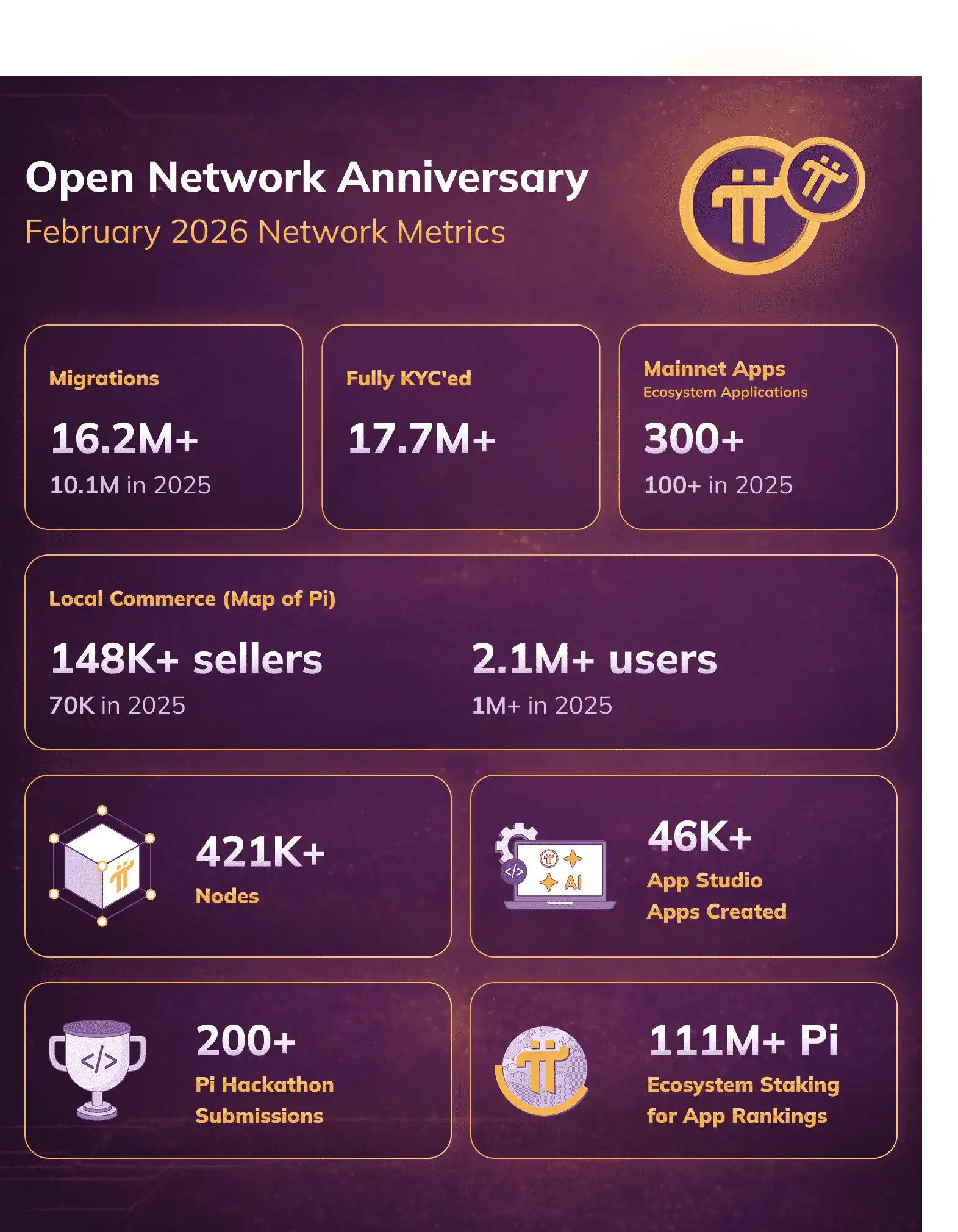
These metrics highlight exponential growth in key areas. For instance, Mainnet migrations surged by over 60%, enabling more Pioneers to participate in on-chain activities. The ecosystem’s application count tripled, fueled by tools like Pi App Studio—a no-code/low-code platform for developers. Local commerce via the Map of Pi platform more than doubled in sellers and users, promoting real-world Pi transactions for goods and services. Additionally, the network’s decentralization strengthened with over 421,000 nodes, while staking mechanisms supported merit-based app visibility.
Progress also included innovative releases such as Pi Network Ventures, decentralized exchange (DEX) and automated market maker (AMM) features, and token creation tools. For deeper insights, the Core Team directed users to prior updates, including the “First 100 Days of Open Network” and “2025 Year-End” blog posts.
Insights from Pi Founders: Q&A on Strategy and Vision
To mark the occasion, Pi Founders Nicolas Kokkalis and Chengdiao Fan released a dedicated Q&A video, addressing community questions on Pi’s unique positioning and future direction. The video, embedded in the blog and available with a full transcript, covers five core topics:
- Why Pi Feels Different from Other Blockchains and Why Utility Matters: The Founders emphasized Pi’s focus on real-world utility over speculation, leveraging a large, verified user base to drive adoption.
- Current Network Priorities: Efforts center on ecosystem development, including app creation via Pi App Studio, ventures, and features like DEX, AMM, and token tools.
- Pi Ecosystem Tokens and Design Thinking on Mainnet: Tokens are designed for utility and product innovation, not capital raising. A new construct requires projects to have functional apps, commit proceeds to liquidity pools for stability, and integrate tokens for user acquisition. This addresses Web3 misalignments where tokens often lack real products.
- Significance of Pi KYC and Next Steps: KYC ensures network integrity and solves broader Web3 identity challenges. Pi plans to offer KYC as a scalable service to third-party Web3 and traditional businesses, featuring global coverage, AI-human hybrid validation, sanction checks, and privacy preservation. Long-term, it will enable services on an identity-verified network.
- Focus on AI and Its Intersection with Blockchain: In an AI-driven world, Pi’s verified human network counters bots and mimics, enabling authentic participation. This ties into solving identity for real-world assets and digital economies.
The Founders described Pi’s token model as a “new design construct based on Pi’s existing resources and infrastructure: utility tokens designed for user acquisition.” Key features include irrevocable liquidity pool deposits, mandatory working products, and engagement-based benefits. A detailed “Pi Request for Comment (PRC)” on ecosystem token design was released on GitHub for community feedback, with options for issues, pull requests, or a Google Form for high-level input.
Looking Ahead: Expansion and Community Focus
The blog outlined ambitious plans for the coming year, prioritizing app and utility creation, tool enhancements, and accelerated KYC/Mainnet migrations. Pi aims to align Web3 tools with product innovations, tackle digital identity challenges, boost interoperability, and improve experiences for developers, businesses, and users.
A major initiative is expanding Pi KYC as a platform capability. In the near term, it will be offered as a service (without sharing user data) to enable global, scalable verification for compliance and real-world integrations. Longer-term, the verified network will support user-controlled data applications, addressing AI-era challenges like distinguishing real humans from bots.
To celebrate the community’s role, Pi announced a forthcoming initiative with commemorative in-app badges for eligible Pioneers—shareable on social media and within apps—and a community raffle. Details on eligibility, timelines, and participation will follow in a dedicated announcement, building excitement toward Pi Day on March 14.
A Milestone for Inclusive Cryptocurrency
Pi Network’s first Open Network anniversary underscores its commitment to a distinct model: utility-first, identity-verified, and user-centric. As the post concludes, “Pi’s approach—the focus on utility, mass adoption, verified-identity, and user experience—reflects a distinct model for widespread, mainstream success and differentiates Pi from the broader blockchain industry.”Pioneers are encouraged to engage by watching the Founders’ video, reviewing the transcript, providing feedback on token designs via GitHub or the form, and staying tuned for celebration details. With over 17.7 million KYC-verified users and a growing ecosystem, Pi continues its path toward becoming an accessible cryptocurrency for everyday use.
For more information, visit the official Pi Network blog or download the Pi mining app. As Pi evolves, its emphasis on real innovation positions it as a leader in bridging blockchain with practical, global utility.
Disclaimer: The views and analysis presented in this article are for informational purposes only and reflect the author’s perspective, not financial advice. Technical patterns and indicators discussed are subject to market volatility and may or may not yield the anticipated results. Investors are advised to exercise caution, conduct independent research, and make decisions aligned with their individual risk tolerance.
About Author: Nilesh Hembade is the Founder and Lead Author of Coinsprobe, with over 5 years of experience in the cryptocurrency and blockchain industry. Since launching Coinsprobe in 2023, he has been providing daily, research-driven insights through in-depth market analysis, on-chain data, and technical research.

The opinions and market insights shared on CoinsProbe represent the views of individual authors based on prevailing market conditions at the time of publication. Cryptocurrency investments carry significant risk and volatility. Readers are encouraged to conduct their own research and seek professional financial advice before making investment decisions. CoinsProbe and its contributors do not accept responsibility for financial losses or decisions made based on published content.
CoinsProbe may publish sponsored articles, affiliate links, or promotional collaborations. All sponsored material is clearly labeled to maintain transparency with our audience. Our editorial decisions remain fully independent, and advertising partnerships do not influence reviews, rankings, or published opinions.
Since 2023, CoinsProbe has delivered reliable insights on cryptocurrency, blockchain, and digital assets. Our content is created by experienced researchers and analysts who follow strict editorial standards focused on accuracy, transparency, and credibility. Every article is carefully reviewed and verified using trusted sources and current market data. We provide unbiased analysis and timely updates covering everything from emerging crypto projects to major industry developments.