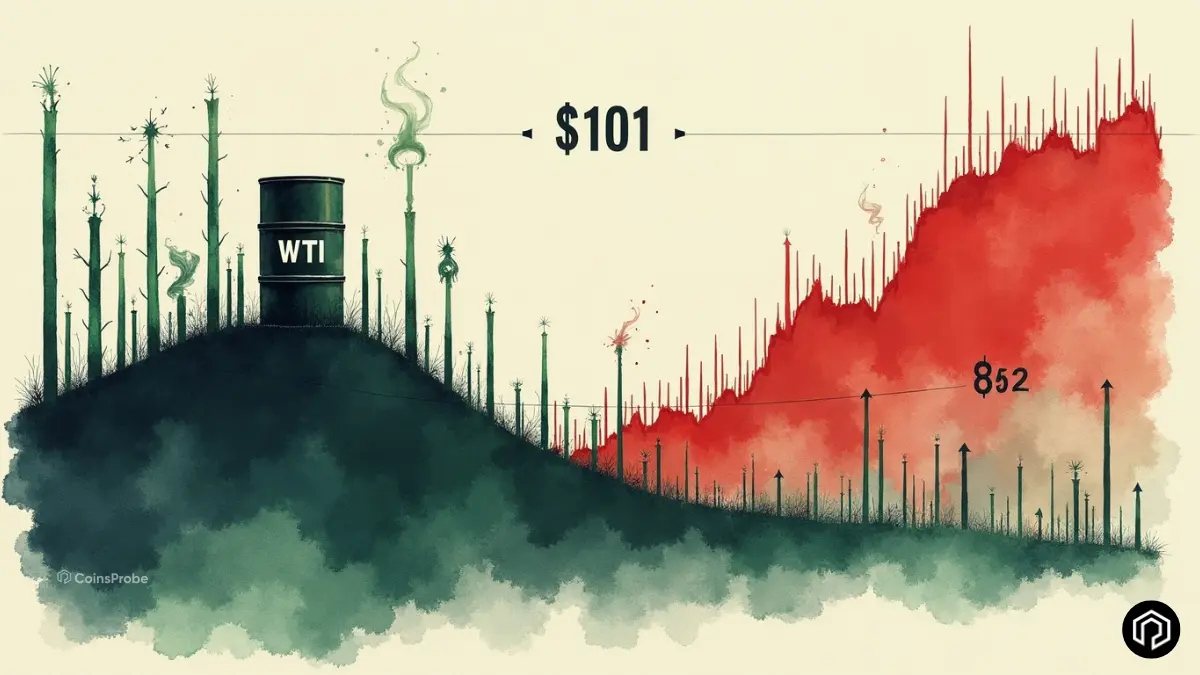

- WTI crude spiked to $99–$101 then crashed to $84.37 in under 27 minutes — one of the sharpest intraday reversals in oil markets in 2026, driven entirely by conflicting US-Iran headlines.
- President Trump announced "very good and productive conversations" with Iran and ordered a 5-day pause on military strikes — briefly erasing the war premium built into oil prices.
- Iran denied all contact within minutes, calling Trump's statement "psychological warfare" and warning that Hormuz will not return to pre-war conditions — reigniting supply disruption fears instantly.
- A Power of 3 (PO3) setup is now forming on the 4H chart — with $84.37 as the key hold zone, $92.06 as the critical reclaim level, and $118.97 as the longer-term bullish target if the setup confirms.
WTI crude oil delivered one of its most volatile intraday sessions in recent memory on March 23, 2026 — spiking toward $99–$101 before collapsing over $15 to a low of $84.37, then partially recovering to close around $93 — down approximately 6–8% on the day. The entire swing was driven by a single geopolitical narrative that reversed itself in under 30 minutes.
The Trigger — Trump’s Optimistic Announcement
The session began with a market-moving post from President Trump on Truth Social, announcing that the US and Iran had held “very good and productive conversations” over the past two days aimed at a “complete and total resolution” of hostilities in the Middle East.
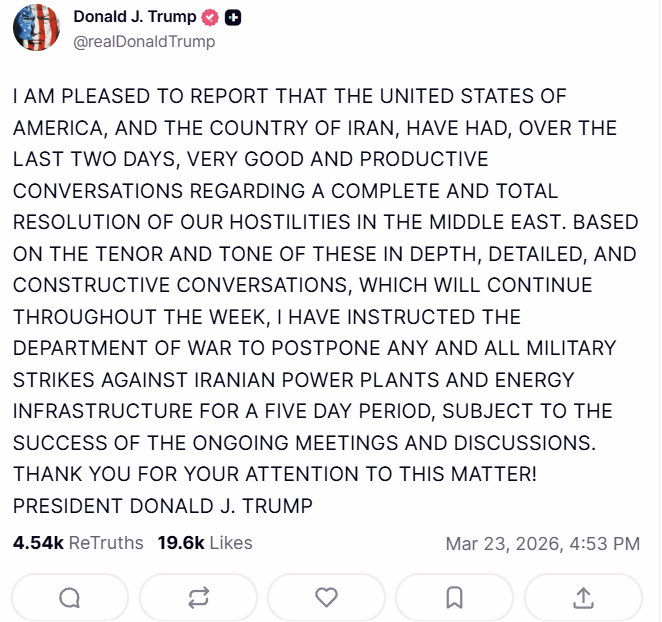
Trump went further — explicitly instructing the Department of Defense to postpone all military strikes on Iranian power plants and energy infrastructure for five days, citing the positive tone of ongoing talks that he said would continue throughout the week.
The announcement came directly after Trump’s prior ultimatum — that Iran must fully reopen the Strait of Hormuz or face devastating strikes on its energy sector. Markets read the postponement as de-escalation. The war premium that had pushed WTI into the $98–$101 range temporarily evaporated, and oil prices initially dipped on reduced supply disruption fears.
Iran’s Denial — 27 Minutes Later
The relief lasted barely half an hour. as Iran issued a categorical denial within minutes:
- “There has been no direct or indirect contact or negotiations with the US”
- Tehran framed Trump’s announcement as a unilateral backdown in response to Iran’s warnings of retaliatory strikes on regional power plants across West Asia
- Iran characterized the statement as “psychological warfare” designed to manipulate markets and public perception
- Iranian officials warned that “Hormuz will not return to pre-war conditions as long as psychological warfare continues”
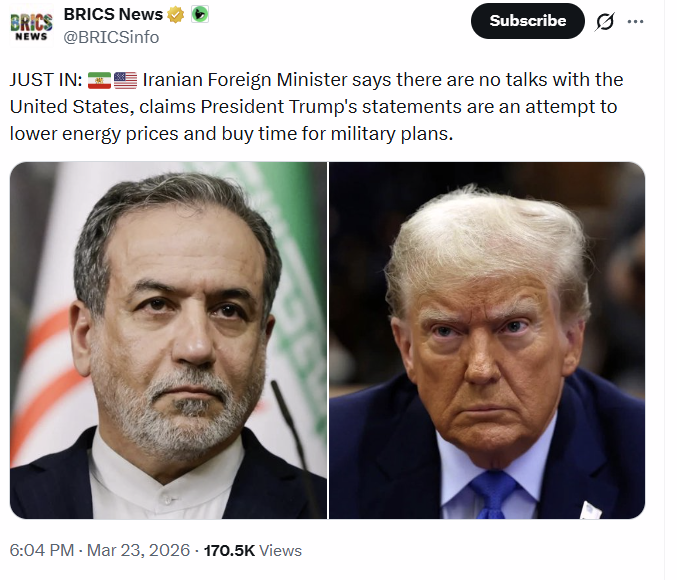
The contradiction immediately reignited uncertainty. Whether back-channel talks occurred through intermediaries such as Oman, whether Trump overstated diplomatic progress, or whether the announcement was pure posturing — the denial was enough to crush the de-escalation narrative entirely.
Chart Analysis — Power of 3 Setup Forming on the 4H
The 4-hour chart on WTI Crude Oil CFDs captures the chaos of the session perfectly — and a technically significant setup is now forming in the aftermath.
Following an extended accumulation zone between $92.06 and $101.67, the intraday volatility pushed price into the manipulation zone before failing to hold the lower boundary. The sharp sell-off following Iran’s denial triggered a liquidity sweep to a low of $84.37 — the most critical level on the chart going forward.
Key Levels:
$84.37 — Today’s low and key hold zone. This is the most important level to watch on a closing basis. As long as WTI holds above $84.37, the Power of 3 setup remains valid and the liquidity sweep is interpreted as manipulation before a potential directional move higher.
$92.06 — Broken support, now critical resistance. The lower boundary of the accumulation range — now flipped to potential resistance after today’s breakdown. A reclaim of this level with strength is the key trigger for the bullish scenario.
$101.67 — Accumulation zone high. The upper boundary of the established range. A breakout above this level — following a confirmed reclaim of $92.06 — would validate the full Power of 3 distribution phase and open the door to the measured move target.
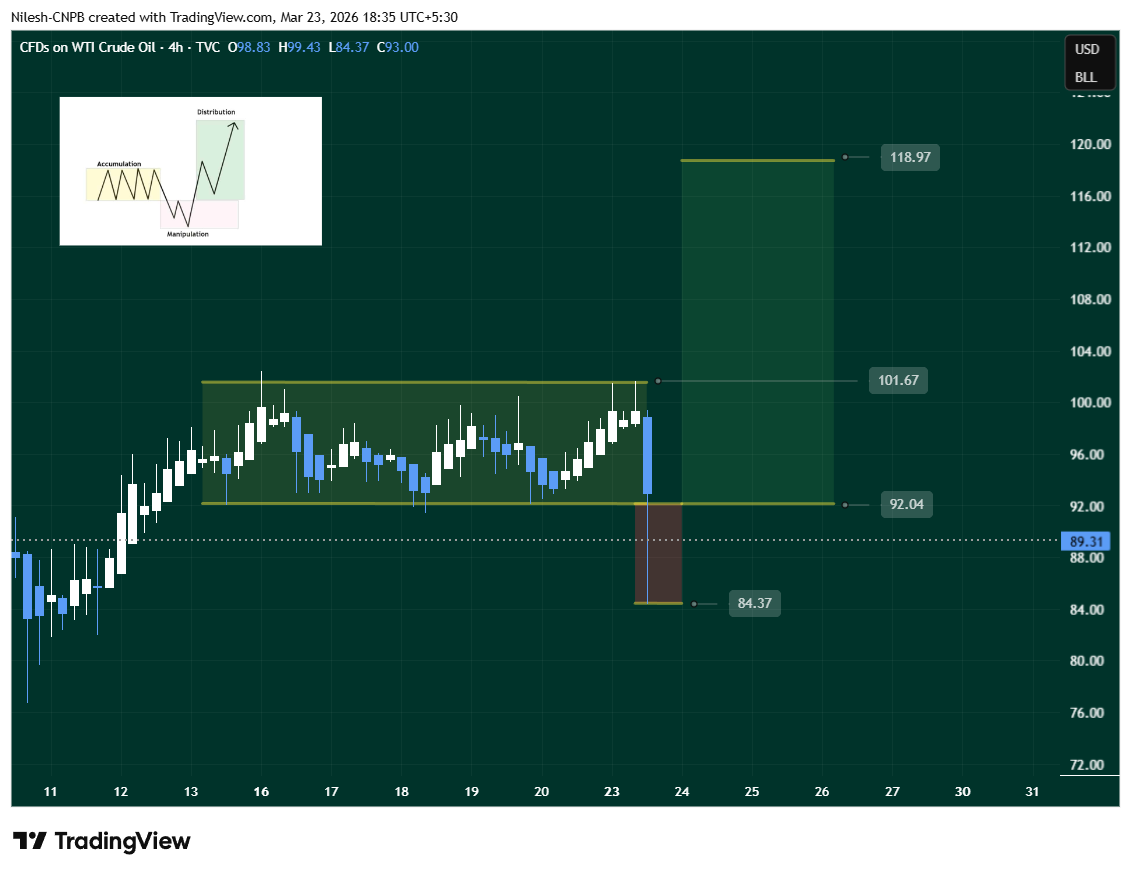
$118.97 — Longer-term bullish target. The full measured move extension from the Power of 3 setup — the target if WTI reclaims $92.06, breaks $101.67, and the bullish scenario fully plays out.
Bullish Scenario
If WTI reclaims above $92.06 with strength and conviction on a 4H closing basis, it would confirm the transition into the distribution phase of the Power of 3 setup. This would set the stage for a breakout above the accumulation zone high at $101.67, with the next major target at $118.97 — a move that would imply renewed escalation fears or a significant supply disruption event driving the next leg higher.
A genuine diplomatic breakthrough — concrete evidence that US-Iran back-channel talks are actually progressing through intermediaries such as Oman — would paradoxically be bearish for oil in the near term, as it would reduce the war premium. The bullish path to $118.97 is more likely driven by escalation than resolution.
Bearish Scenario
A decisive daily close below $84.37 invalidates the Power of 3 setup entirely. This would signal that the liquidity sweep was not manipulation but a genuine breakdown — opening the door to further downside in the $80s and potentially lower if escalation fears intensify without a corresponding supply response from OPEC or alternative producers.
The short-term bearish bias remains intact as long as WTI trades below the $92–$93 broken support zone, which now acts as overhead resistance on any recovery attempt.
Why This Matters Beyond Oil
Today’s WTI session is not just an oil story — it has direct macro implications for crypto and broader risk assets:
Inflation pressure — Higher and more volatile oil prices feed directly into inflation data, forcing the Fed to maintain a cautious stance on rate cuts and keeping liquidity conditions tighter than risk assets prefer.
Risk-off spillover — Sustained oil volatility driven by Middle East escalation creates risk-off sentiment that pressures equities and crypto simultaneously. Today’s crypto short squeeze on Trump’s announcement — followed by Iran’s denial — mirrors the oil market’s whipsaw almost perfectly.
The Strait of Hormuz threat remains the most critical variable — with approximately 20% of global oil supply passing through it daily, any credible move to restrict or close the strait would send both oil and inflation expectations sharply higher, creating cascading effects across all risk asset classes.
Frequently Asked Questions
What caused WTI crude to crash $15 in under 27 minutes on March 23, 2026?
The crash was triggered by a rapid geopolitical reversal — President Trump announced productive US-Iran talks and a 5-day pause on military strikes, briefly erasing oil’s war premium. Within 27 minutes, Iran issued an official denial of any contact, reigniting supply disruption fears and triggering aggressive risk-off selling that sent WTI from $101 to $84.37.
What is the Power of 3 (PO3) pattern in trading?
The Power of 3 is a price action concept describing three phases — Accumulation (range building), Manipulation (a false move to trap traders in one direction), and Distribution (the real directional move). On WTI’s 4H chart, the spike to $101 followed by the crash to $84.37 represents the manipulation phase — with the direction of the distribution phase now dependent on whether $92.06 is reclaimed or $84.37 breaks.
What is the Strait of Hormuz and why does it matter for oil prices?
The Strait of Hormuz is the world’s most critical oil chokepoint, with approximately 20% of global oil supply passing through it daily. Iran’s repeated threats to restrict or close the strait during the ongoing conflict have created a persistent war premium in oil prices. Any credible move to act on this threat would trigger an immediate and severe oil price spike with global inflation implications.
What level must WTI hold to keep the bullish scenario valid?
WTI must hold above $84.37 on a daily closing basis to keep the Power of 3 bullish setup valid. A close below this level invalidates the setup and opens the door to further downside. The key reclaim level for the bullish scenario is $92.06 — a strong 4H close above this level would confirm the distribution phase and target $101.67 then $118.97.

The opinions and market insights shared on CoinsProbe represent the views of individual authors based on prevailing market conditions at the time of publication. Cryptocurrency investments carry significant risk and volatility. Readers are encouraged to conduct their own research and seek professional financial advice before making investment decisions. CoinsProbe and its contributors do not accept responsibility for financial losses or decisions made based on published content.
CoinsProbe may publish sponsored articles, affiliate links, or promotional collaborations. All sponsored material is clearly labeled to maintain transparency with our audience. Our editorial decisions remain fully independent, and advertising partnerships do not influence reviews, rankings, or published opinions.
Since 2023, CoinsProbe has delivered reliable insights on cryptocurrency, blockchain, and digital assets. Our content is created by experienced researchers and analysts who follow strict editorial standards focused on accuracy, transparency, and credibility. Every article is carefully reviewed and verified using trusted sources and current market data. We provide unbiased analysis and timely updates covering everything from emerging crypto projects to major industry developments.