

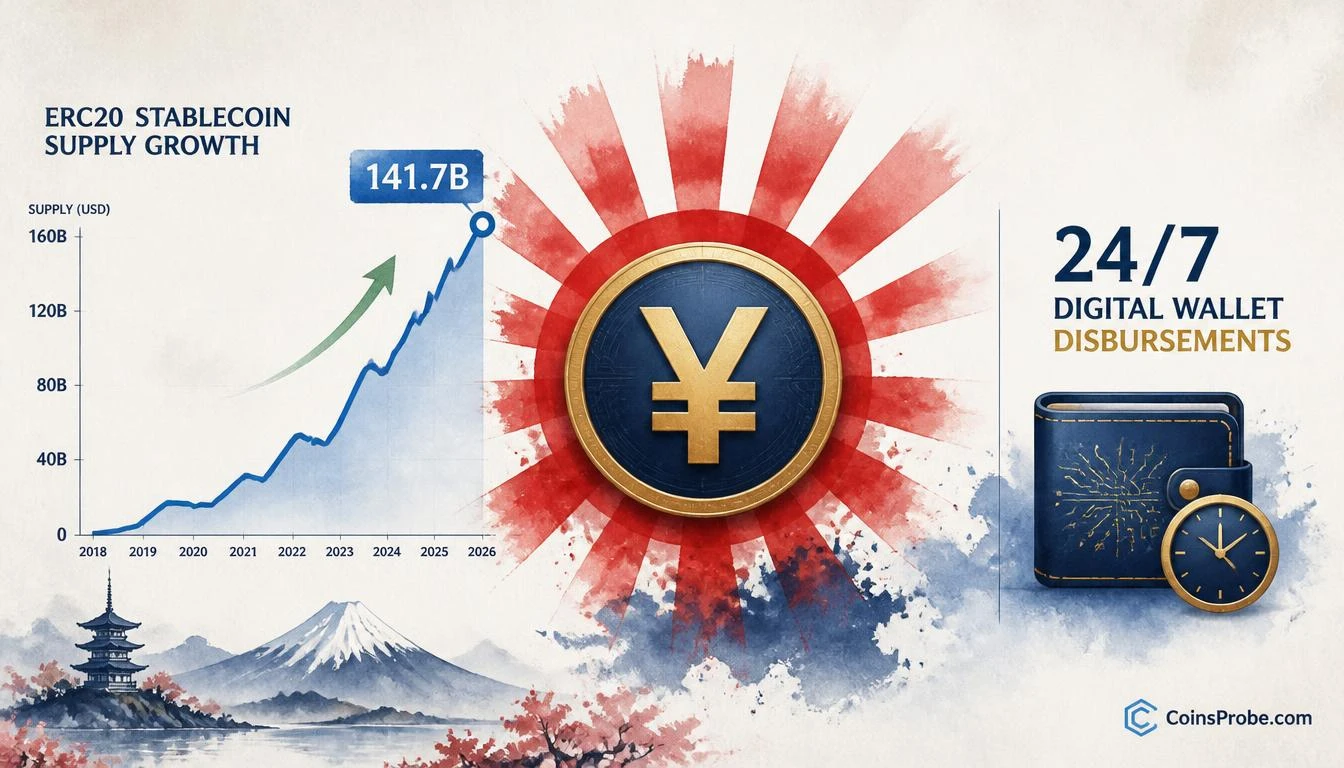

- Japan's government formally enters policy discussions on yen-backed stablecoins for 24/7 digital wallet disbursements — per @xwinfinance via CryptoQuant
- ERC20 stablecoin total supply stands at 141.7B — more than double the 2022 peak of ~100B, signaling infrastructure at sovereign-relevant scale
- Use case: government refunds settled directly to digital wallets around the clock, bypassing standard banking-hours settlement rails
- Japan would be the first G7 economy to deploy stablecoin infrastructure for domestic public-sector payments if formalized
Japan’s government has formally entered discussions around yen-backed stablecoins as a mechanism for direct digital wallet disbursements — a policy shift that arrives as the total supply of ERC20 stablecoins reaches 141.7 billion, more than doubling its 2022 peak of roughly 100 billion. This is not a speculative narrative. It is a government-level engagement with stablecoin infrastructure as legitimate financial plumbing.
CryptoQuant analyst @xwinfinance, writing via the CryptoQuant Quicktake platform and amplified by @cryptoquant_com, frames the development with precision: “Yen-backed stablecoins could offer a new option: refunds sent directly to digital wallets, potentially around the clock.” The implication is structural — Japan is not discussing stablecoins as a speculative asset class but as a 24/7 payment rail embedded into government disbursement workflows.
The Policy Context — Why Japan, Why Now
Japan has historically been one of the most deliberate regulatory jurisdictions in digital asset policy. Its Payment Services Act, revised multiple times since 2017, already provides one of the world’s most developed legal frameworks for crypto assets. The introduction of yen-backed stablecoins into government policy discussions represents a meaningful escalation — moving from exchange regulation toward sovereign-adjacent digital currency infrastructure.
The specific use case @xwinfinance identifies — refunds sent directly to digital wallets around the clock — targets a genuine inefficiency in traditional government payment systems. Standard banking rails in Japan, as in most developed markets, operate within business hours and clear through correspondent banking layers. A yen-backed stablecoin on a public blockchain would bypass those constraints entirely, enabling real-time settlement at any hour. This is the same argument that has driven USDC and USDT adoption in cross-border remittance corridors — applied now to domestic government disbursements in the world’s third-largest economy.
ERC20 Stablecoin Supply at 141.7B — The Infrastructure Is Already There
The chart shared by @cryptoquant_com contextualizes this policy discussion against the actual scale of stablecoin infrastructure that has been built. ERC20 stablecoin total supply sat near zero in 2018, reached approximately 100 billion at its 2022 peak, consolidated through 2022–2023, and then surged again through 2024–2026 to a peak near 160 billion before settling at the current reading of 141.7 billion.
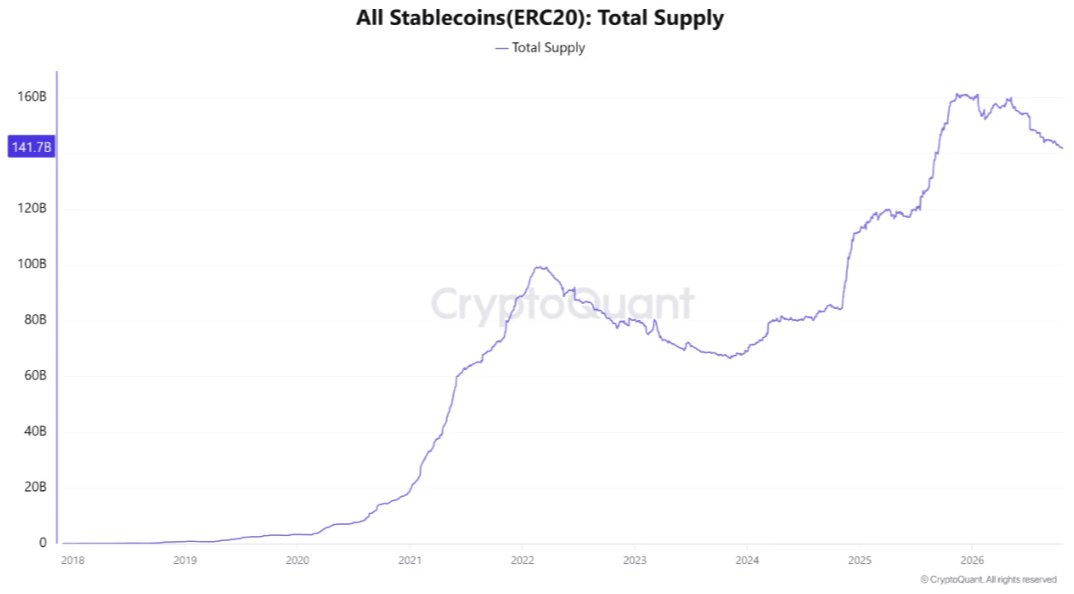
That trajectory matters for understanding why government engagement is happening now. The supply base is no longer experimental. 141.7 billion dollars in stablecoin supply on the Ethereum network alone represents a payment network at scale — one that has already processed trillions in transaction volume across DeFi protocols, cross-border transfers, and institutional settlement. When Japan’s government discusses yen-backed stablecoins, it is entering a market with proven infrastructure, not proposing one from scratch. For context on how on-chain signals are tracking across major assets in this environment, see our recent coverage of BTC, HYPE, and ZEC flashing TD Sequential buy signals.
What a Yen-Backed Stablecoin Would Structurally Require
A government-adjacent yen stablecoin differs from a commercial issuer like Circle or Tether in one critical dimension: reserve transparency and regulatory enforceability. Japan’s Financial Services Agency would almost certainly require full yen reserves, real-time attestation, and integration with existing KYC/AML frameworks. This is not a deregulatory proposal — it is a proposal to bring stablecoin mechanics inside the existing regulatory perimeter.
The 24/7 disbursement capability @xwinfinance highlights would require smart contract automation — the same infrastructure already running on Ethereum at scale. Whether Japan opts for an ERC20-compatible implementation, a domestic blockchain, or a hybrid model remains an open question. But the policy discussion itself signals that the mechanism is no longer being dismissed as incompatible with government standards.
Global Implications — Japan as a Regulatory Signal
Japan’s regulatory posture in digital assets has historically influenced peer jurisdictions in Asia and beyond. Its 2017 recognition of Bitcoin as legal tender for payments preceded broader Asian regulatory engagement by years. If Japan formalizes a yen-backed stablecoin framework — even a limited one for government disbursements — it would represent the first G7 economy to deploy stablecoin infrastructure for domestic public-sector payments.
That precedent would carry weight. The EU’s MiCA framework already creates a legal pathway for euro-denominated stablecoins. The US has seen multiple stablecoin bills advance through committee. Japan moving first in the G7 on a government-use stablecoin would accelerate that legislative timeline elsewhere. For readers tracking macro positioning across major assets in this environment, our analysis of BTC, ETH, and XRP rebound targets provides relevant on-chain context.
Bullish Scenario
Japan formalizes a yen-backed stablecoin framework for government disbursements within 12–18 months, triggering parallel regulatory processes in South Korea, Singapore, and EU member states. ERC20 stablecoin supply, already at 141.7 billion, resumes its 2024–2026 growth trajectory as institutional and sovereign demand layers onto existing commercial demand. Crypto-adjacent infrastructure tokens — layer-1 settlement networks, stablecoin issuers, and compliance middleware — reprice materially on confirmed regulatory adoption.
Bearish Scenario
Japan’s policy discussions remain at the exploratory stage without legislative action, consistent with the country’s historically cautious regulatory timeline. A government-issued stablecoin competes directly with commercial issuers rather than complementing them, suppressing private stablecoin adoption in the Japanese market. ERC20 supply growth plateaus if sovereign alternatives fragment the market rather than expand it.
The structural shift is already underway — 141.7 billion in ERC20 stablecoin supply is not a forecast, it is the current state of the network. Japan’s government entering formal policy discussions around that infrastructure is the confirmation that stablecoins have crossed from peripheral to mainstream financial consideration. Watch the Financial Services Agency’s legislative calendar: formal bill introduction would be the confirmation signal that moves this from policy discussion to structural reality.
Frequently Asked Questions
What specific use case is Japan’s government considering for yen-backed stablecoins?
How large is the ERC20 stablecoin market that Japan would be entering?
Would a Japanese government stablecoin compete with USDT and USDC?
Why does Japan’s regulatory stance matter for global stablecoin policy?
Source: CryptoQuant · Published by CoinsProbe Markets Desk
The opinions and market insights shared on CoinsProbe represent the views of individual authors based on prevailing market conditions at the time of publication. Cryptocurrency investments carry significant risk and volatility. Readers are encouraged to conduct their own research and seek professional financial advice before making investment decisions. CoinsProbe and its contributors do not accept responsibility for financial losses or decisions made based on published content.
CoinsProbe may publish sponsored articles, affiliate links, or promotional collaborations. All sponsored material is clearly labeled to maintain transparency with our audience. Our editorial decisions remain fully independent, and advertising partnerships do not influence reviews, rankings, or published opinions.
Since 2023, CoinsProbe has delivered reliable insights on cryptocurrency, blockchain, and digital assets. Our content is created by experienced researchers and analysts who follow strict editorial standards focused on accuracy, transparency, and credibility. Every article is carefully reviewed and verified using trusted sources and current market data. We provide unbiased analysis and timely updates covering everything from emerging crypto projects to major industry developments.