
Bitcoin is flashing strength again. As of March 4, 2026, BTC is trading around $71,600 — up over 7% in the past 24 hours — after rebounding sharply from a 24-hour low of $66,237. Total crypto market capitalization has jumped 5.41% to $2.42 trillion, supported by two consecutive days of positive Bitcoin spot ETF net inflows.
But beyond the short-term bounce, a much larger narrative is building on the weekly chart — one that draws a striking parallel to Alphabet Inc. (Google) before one of the most powerful continuation rallies in tech stock history.
What Is a Macro Fractal and Why Does It Matter?
Before diving into the Bitcoin-Google comparison, it helps to understand what analysts mean by a “macro fractal.”
A fractal in market analysis refers to a repeating structural pattern that appears across different assets, time periods, or market cycles. When two assets share similar macro conditions — accumulation zones, breakout patterns, corrective structures — traders use fractals as high-probability roadmaps for potential future price behavior.
Fractals are not guarantees. But when a fractal aligns with multiple technical confirmations across higher timeframes, it becomes a serious analytical tool rather than speculation.
Bitcoin vs. Alphabet: The Structural Comparison
Prominent on-chain analyst CryptoAmsterdam recently highlighted a compelling chart comparison showing Bitcoin’s current weekly structure closely mirroring Alphabet Inc.’s (GOOG) macro pattern from 2022 to 2024.
The repeating structure in both cases follows this sequence:
Macro cycle → Breakout → Mini cycle retest → Continuation of macro trend
Alphabet’s Roadmap (2022–2024)
Google’s parent company Alphabet went through a textbook macro accumulation phase between 2022 and 2024:
- Large macro accumulation: GOOG spent over 12 months building a base after the 2022 tech sector crash
- Breakout above resistance: Price reclaimed and held key structural levels around $140
- Pullback to key level: A corrective retest tested patience before the real move
- Explosive continuation: Once $140 was decisively reclaimed, GOOG advanced aggressively toward nearly $340 — a move of approximately 143% from the breakout level
The entire move was not a straight line. It involved a painful corrective phase that shook out weak hands before the macro continuation resumed.
Bitcoin’s Current Structure (2021–2026)
Bitcoin’s weekly chart is now displaying a remarkably similar sequence:
- Completed macro cycle (2021–2023): BTC peaked near $69,000 in November 2021, then entered a deep bear market bottoming around $15,500 in late 2022
- Breakout in 2024: Bitcoin broke above previous cycle highs and surged to a new all-time high above $126,000 in late 2025
- Mini cycle retest (late 2025–early 2026): Following the ATH, BTC entered a corrective descending channel — a “mini cycle within the bigger cycle”
- Critical support defense at $60K: In February 2026, Bitcoin tested the lower boundary of the macro structure near $59,980 and held
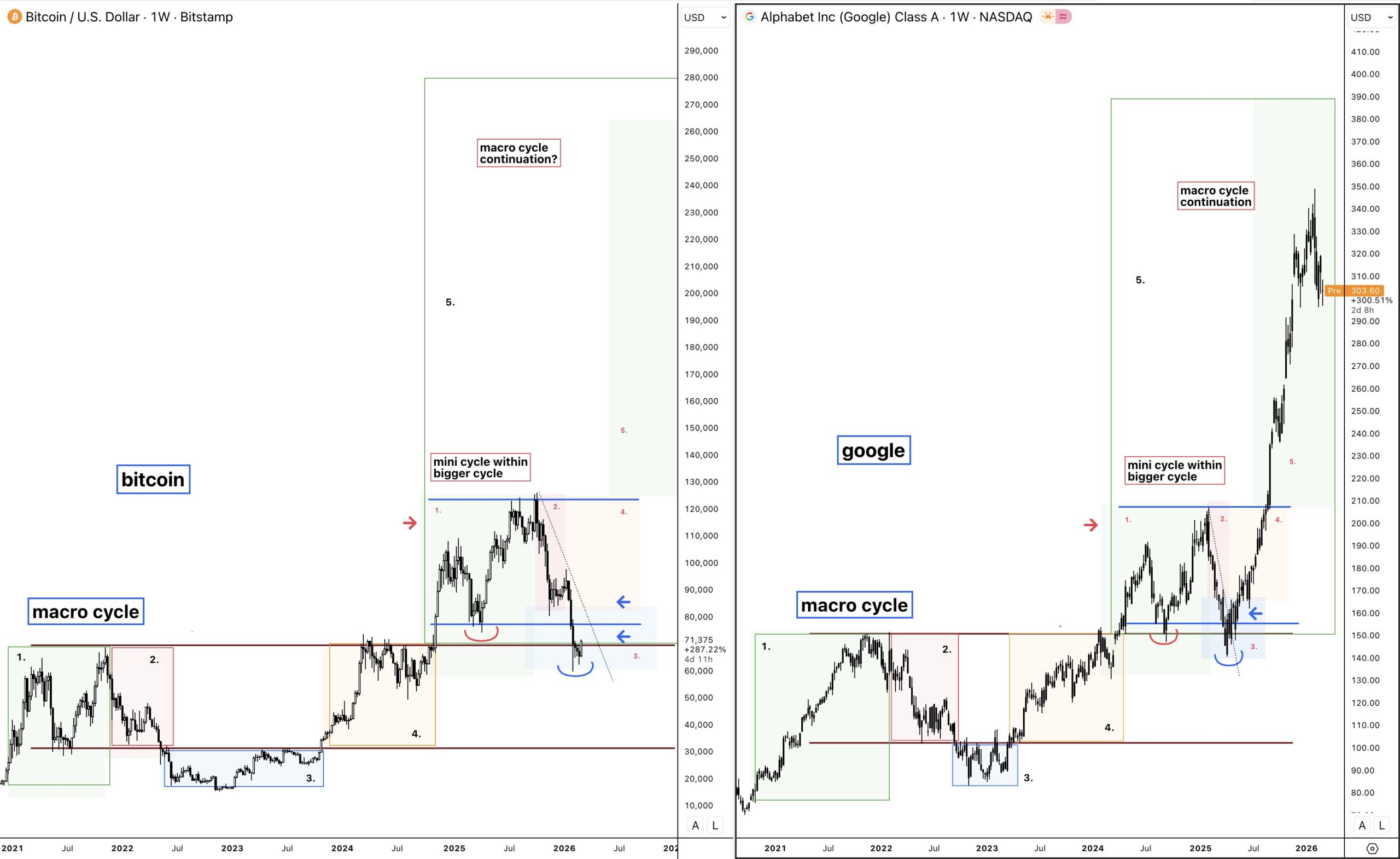
This defense of the $60,000 zone is the most important data point in this analysis.
The $60,000 Defense — Why It Matters
Last month, Bitcoin dipped toward the $60,000 region during peak geopolitical panic following military strikes in the Middle East. This zone aligned precisely with the lower boundary of Bitcoin’s macro corrective structure.
Instead of breaking down, price held firm and quickly reclaimed $70,000.
This behavior mirrors exactly what happened with Alphabet during its critical pullback:
| Factor | Alphabet (GOOG) 2023 | Bitcoin (BTC) 2026 |
|---|---|---|
| Key support level | ~$140 structural zone | ~$60,000 macro boundary |
| Seller behavior | Failed to break structure | Failed to break structure |
| Recovery speed | Reclaimed resistance quickly | Reclaimed $70K within days |
| Signal | Macro continuation setup | Macro continuation setup |
In both cases, the lower macro support held. Sellers could not break structure decisively. And price began reclaiming key horizontal levels immediately after the test.
The descending corrective channel on Bitcoin’s weekly chart is now compressing toward its upper resistance — a technical condition that typically precedes expansion when it aligns with a higher timeframe macro continuation setup.
ETF Inflows Signal Institutional Confidence
Adding weight to the macro fractal thesis, Bitcoin spot ETFs have recorded positive net inflows for two consecutive days heading into March 4, 2026.
This is significant because during the February correction — when BTC dropped from $90,000+ to near $60,000 — ETF outflows were consistent and heavy, suggesting institutional holders were reducing risk. The reversal of those outflows now suggests:
- Institutional buyers are re-entering at current levels
- The $60,000–$70,000 zone is being treated as a value area by large players
- Smart money may be positioning ahead of a potential macro continuation
ETF flow reversals have historically preceded meaningful Bitcoin price recoveries. The January 2024 ETF approval period saw sustained inflows drive BTC from $40,000 to $73,000.
Two Confirmations Required for Fractal Validation
Analyst CryptoAmsterdam and broader market consensus identify two specific price levels that must be cleared for the Bitcoin-Google fractal to fully validate:
Confirmation 1 — Break Above $79,000 (Trendline Resistance)
A decisive weekly close above $79,000 would confirm a breakout from the descending corrective channel that has defined Bitcoin’s price action since the 2025 all-time high. This is the first and most immediate test.
Until this level is reclaimed on a weekly closing basis, the corrective channel structure remains intact and lower highs remain possible.
Confirmation 2 — Reclaim of $126,000 (Macro Expansion Trigger)
The bigger macro trigger is a sustained move above the previous all-time high zone near $126,000. This would mirror Alphabet’s decisive reclaim of its structural resistance — the move that triggered the full 143% continuation phase.
A confirmed weekly close above $126,000 would, in this framework, signal that Bitcoin has entered the expansion phase of its macro cycle — not just a relief bounce.
What Could Invalidate This Setup?
No fractal analysis is complete without understanding what breaks it. The Bitcoin-Google thesis would be invalidated if:
- BTC loses $62,500 on a weekly closing basis — this would suggest the lower macro support has failed
- ETF outflows resume at scale after the current inflow reversal
- Macro conditions deteriorate further — a significant escalation in Middle East tensions or unexpected Fed tightening could override technical structure
- Rejection at $79,000 with high volume selling — a clean rejection at trendline resistance would reset the timeline significantly
Keeping these invalidation conditions in mind is as important as tracking the bullish confirmation levels.
What to Watch This Week
With U.S. equity markets active and Bitcoin ETFs in full participation, several key developments could accelerate or delay the fractal setup:
Bullish triggers:
- Weekly close above $72,000–$73,000 (building momentum)
- Continued ETF net inflows for a third consecutive day
- Crypto total market cap holding above $2.4 trillion
Warning signs:
- Rejection below $70,000 after current rally
- Return of ETF outflows
- BTC failing to break $75,000 within the next two weeks
Bottom Line
Bitcoin is currently at one of the most structurally significant moments of its 2025–2026 cycle. The macro fractal comparison with Alphabet Inc. is compelling precisely because both assets share the same sequence: macro breakout → corrective channel → critical support defense → potential continuation.
The $60,000 defense in February 2026 mirrors Google’s own critical test before its explosive continuation to $340.
Two price levels now define the narrative: $79,000 for trendline confirmation and $126,000 for full macro expansion validation.
Whether Bitcoin is simply bouncing from geopolitical panic — or positioning for a historic expansion phase — the next few weekly closes will likely provide the answer.
FAQ:
What is the Bitcoin-Google fractal comparison?
It refers to a structural similarity between Bitcoin’s current weekly chart (2021–2026) and Alphabet Inc.’s macro price pattern (2022–2024). Both show a macro breakout followed by a corrective descending channel and a critical support defense before potential continuation.
Why is the $60,000 Bitcoin level so important in 2026?
The $60,000 zone represented the lower boundary of Bitcoin’s macro corrective structure in early 2026. Its defense in February — during peak geopolitical panic — mirrors how Alphabet held its key $140 structural zone before an explosive 143% continuation rally.
What price does Bitcoin need to confirm a bullish macro breakout?
According to the fractal analysis, Bitcoin needs a decisive weekly close above $79,000 to break the descending channel trendline, and a sustained move above $126,000 to confirm full macro expansion — mirroring Alphabet’s historic breakout and continuation phase.
What would invalidate the Bitcoin bullish fractal?
The setup would be invalidated by a weekly close below $62,500, a return of heavy ETF outflows, or a clean rejection with high volume at the $79,000 trendline resistance.

The opinions and market insights shared on CoinsProbe represent the views of individual authors based on prevailing market conditions at the time of publication. Cryptocurrency investments carry significant risk and volatility. Readers are encouraged to conduct their own research and seek professional financial advice before making investment decisions. CoinsProbe and its contributors do not accept responsibility for financial losses or decisions made based on published content.
CoinsProbe may publish sponsored articles, affiliate links, or promotional collaborations. All sponsored material is clearly labeled to maintain transparency with our audience. Our editorial decisions remain fully independent, and advertising partnerships do not influence reviews, rankings, or published opinions.
Since 2023, CoinsProbe has delivered reliable insights on cryptocurrency, blockchain, and digital assets. Our content is created by experienced researchers and analysts who follow strict editorial standards focused on accuracy, transparency, and credibility. Every article is carefully reviewed and verified using trusted sources and current market data. We provide unbiased analysis and timely updates covering everything from emerging crypto projects to major industry developments.