
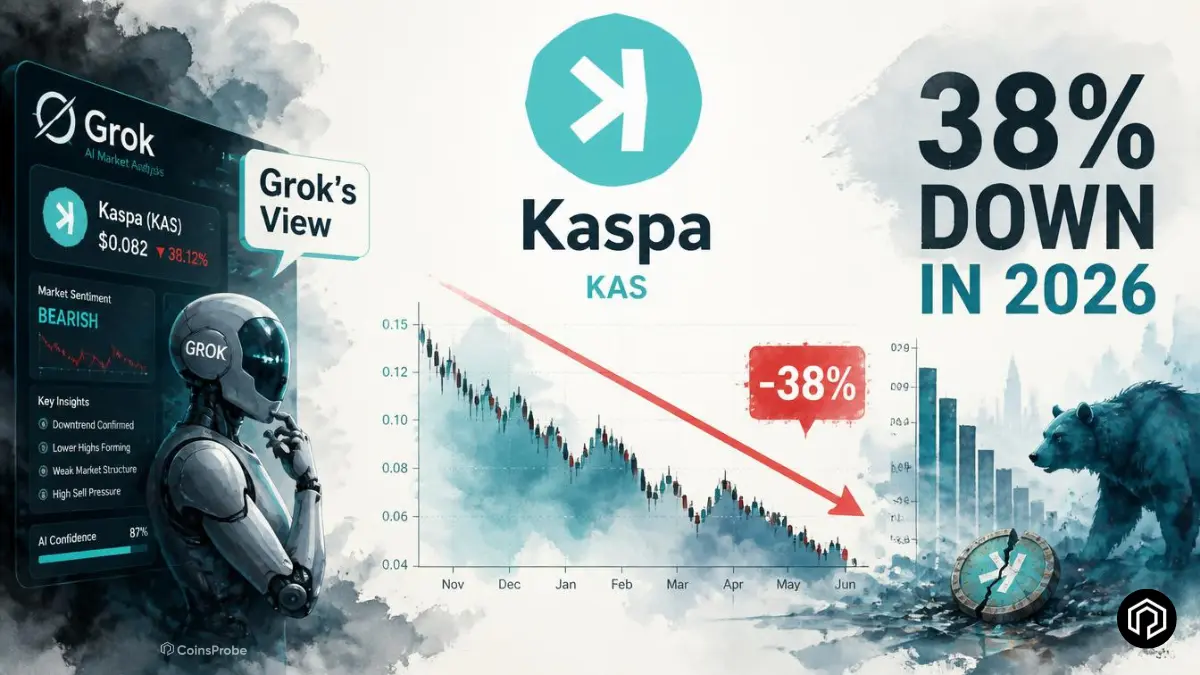

- Kaspa (KAS) trades near $0.0265, down about 38% YTD, in line with the broader altcoin market.
- The Toccata hard fork added KRC-20 tokens, native covenants, ZK proofs, and smart contract capabilities.
- A declining hashrate has increased selling pressure as unprofitable miners exit the network.
- Despite recent weakness, Toccata strengthens Kaspa's long-term outlook as a programmable PoW Layer-1.
Kaspa’s -38% YTD decline is painful — but understanding its causes requires separating what is Kaspa-specific from what is simply 2026’s broader crypto market reality. The analysis below does exactly that.
KAS is trading near $0.0265 — down approximately -38% year-to-date — in a year where Ethereum itself has lost approximately the same percentage. This comparison matters: when the second-largest cryptocurrency by market cap is down -38%, mid-cap and smaller Proof-of-Work projects like Kaspa face amplified selling from the same risk-off forces — plus their own token-specific headwinds on top.

Reason 1 — Broader Market Weakness (The Primary Driver)
The single largest factor in KAS’s 2026 decline is not Kaspa-specific — it is the same macro and crypto market environment that has weighed on virtually every non-Bitcoin asset this year.
2026’s risk-off environment has been characterised by sustained pressure across altcoins — a combination of risk-off macro sentiment, a stronger US dollar reducing global liquidity, and Federal Reserve policy that has kept rate cut expectations subdued for most of the year. We documented the scale of this in our 5-year altcoin sell pressure extreme article — $209 billion in net outflows with only 36 of the top 100 altcoins remaining profitable for holders.
Kaspa as a high-beta asset amplifies Bitcoin’s moves in both directions — rising faster in bull markets and falling harder in bear ones. In an environment where Bitcoin itself has declined -26% year-to-date, KAS’s -38% decline is broadly consistent with its historical beta relationship to the broader market. The comparison to Ethereum (-38% YTD) is not coincidental — both assets are pricing in the same macro headwinds at similar magnitudes.
Reason 2 — “Sell the News” After the Toccata Upgrade
The Toccata hard fork — Kaspa’s most significant protocol upgrade to date — activated on June 30, 2026, delivering native programmability, KRC-20 tokens, and ZK capabilities. By every technical measure, this was a successful and consequential upgrade.
The price reaction was the opposite of what the technical significance might suggest — a classic “sell the news” dynamic.
Why this happened: In the weeks leading up to the Toccata activation, KAS had been trading with positive momentum as anticipation of the upgrade built — traders and investors buying in expectation of the technical milestone. Once the upgrade went live and delivered what was promised, the most natural next action for short-to-medium term holders who had positioned for the catalyst was to exit with profits. The absence of a new immediate catalyst post-activation left price vulnerable to this profit-taking wave.
This pattern — where a highly anticipated technical upgrade triggers selling rather than buying at the moment of delivery — is one of the most documented dynamics in crypto markets. The upgrade itself was not the problem. The market’s positioning ahead of it was.
Reason 3 — Weak Ecosystem Retention Post-Toccata
Beyond the sell-the-news dynamic, the post-Toccata ecosystem metrics have not yet provided the sustained demand signals that would support price recovery:
Early KRC-20 activity faded rapidly — the initial launch of KRC-20 tokens on Kaspa generated significant attention and trading volume in the first days and weeks after Toccata activation. But early-stage token launches on newly programmable chains frequently follow the same pattern: explosive initial interest followed by sharp normalisation as the novelty fades and only genuine use cases survive. Kaspa’s KRC-20 ecosystem is still in this early normalisation phase.
Reason 4 — Miner Capitulation and Falling Hashrate
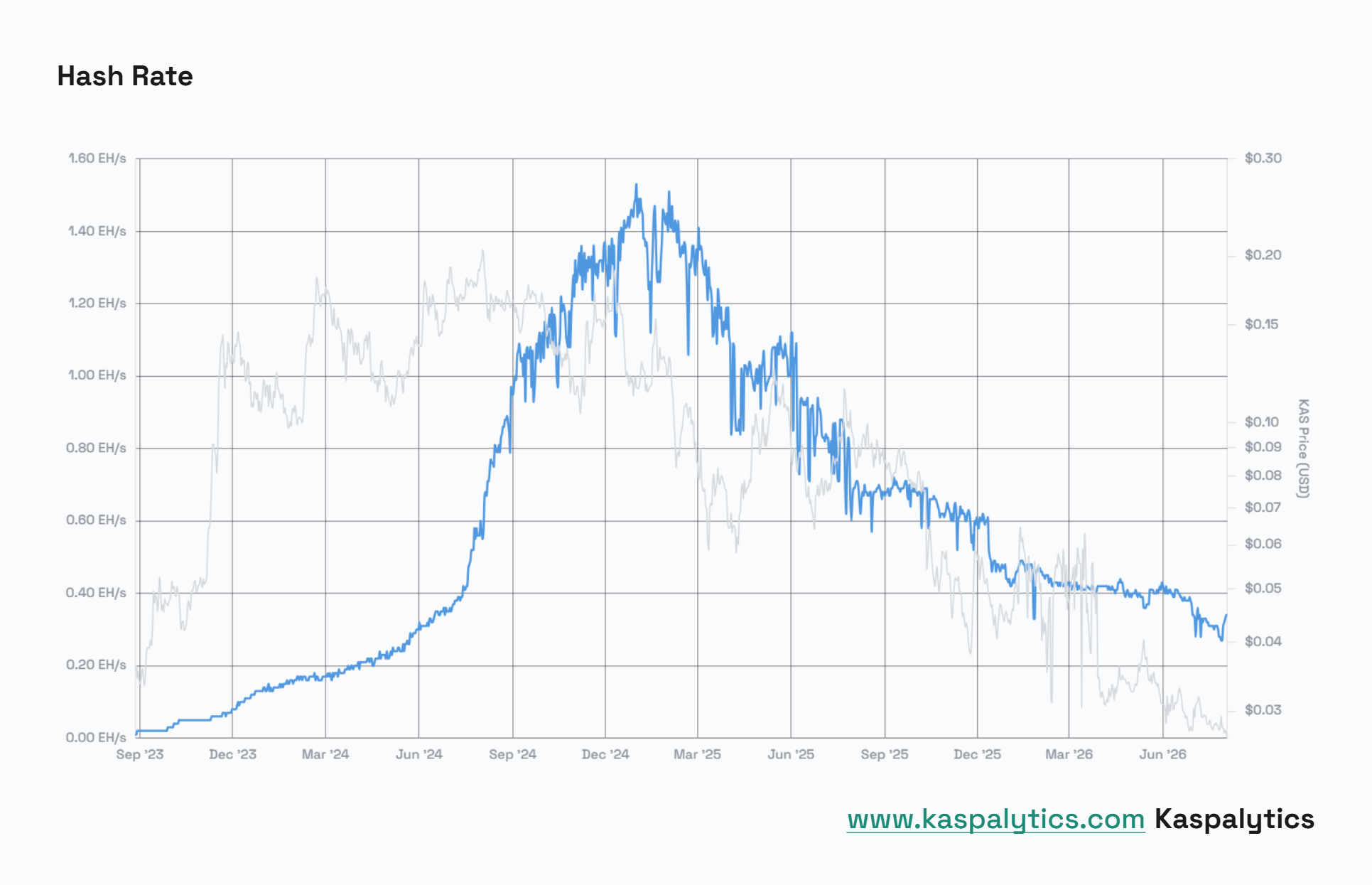
The Kaspalytics hash rate chart provides the clearest visualisation of Kaspa’s current mining economics challenge — and why it creates structural selling pressure on top of the market-driven decline.
Reading the chart:
The blue line (hash rate) shows Kaspa’s network hash rate rising dramatically from approximately 0.05 EH/s in September 2023 to a peak of approximately 1.50 EH/s in December 2024 — a 30x expansion driven by the combination of rising KAS price and the deployment of purpose-built ASIC mining hardware.
From that December 2024 peak, the hash rate has declined consistently — falling to approximately 0.30 EH/s by mid-2026 — as the combination of falling KAS price and competitive mining economics forced less efficient equipment offline.
The grey line (KAS price) shows the same trajectory — peaking near $0.28–$0.30 in late 2024 and declining to the current ~$0.0265–$0.04 range.
Why falling hashrate creates selling pressure:
Miners who remain operational at current prices face a difficult economics equation. With KAS at ~$0.0265 and many miners operating at or near their break-even cost, the incentive to immediately sell mined KAS for fiat to cover electricity and operational costs is high. This creates a consistent, daily supply of KAS entering the market from miners — a structural selling pressure that exists independently of trading sentiment.
As hashrate continues declining, this miner-driven supply should gradually reduce — fewer active miners means less daily mined supply being sold. But the transition is not immediate, and in the near term the miner capitulation dynamic remains a headwind.
What Is the Toccata Upgrade — The Full Technical Picture
For readers unfamiliar with what Kaspa delivered on June 30 — here is a complete breakdown of Toccata’s changes and why they matter:
Before Toccata: Kaspa was primarily a high-speed Proof-of-Work payments network, known for its BlockDAG architecture that achieves 10 blocks per second with high security. Impressive technically — but limited in programmability compared to smart contract platforms.
After Toccata: Kaspa is a programmable Layer-1 with native covenant support, token issuance, ZK verification, and app-specific sequencing — while keeping its high-throughput PoW design intact.
| Feature | What It Enables |
|---|---|
| Native Covenants | Programmable spending rules on UTXOs — vaults, escrow, automated payments, stateful applications |
| Covenant IDs | Persistent identity for covenant UTXOs — true state continuity |
| SilverScript | High-level language that compiles to native Kaspa script — makes building safer and more accessible |
| KRC-20 Tokens | Native token standard embedded in the UTXO model — atomic transfers, lower friction |
| ZK Proof Verification | Native verification of Groth16 and RISC Zero proofs — privacy apps, trust-minimized bridges, verifiable computation |
| Partitioned Sequencing (KIP-21) | App-specific sequencing lanes — better scalability for applications |
| Transaction v1 + Introspection | Expanded scripting power — more flexible and powerful smart logic |
The key architectural distinction: Kaspa did not adopt an EVM-style account model. It remains UTXO-based. Covenants allow UTXOs themselves to carry and enforce state rules — a different and potentially more efficient approach to programmability than Ethereum’s account model. This means Kaspa’s programmability is not EVM-compatible by design — a trade-off that preserves its core architecture but limits immediate developer portability from the Ethereum ecosystem.
How Toccata Positions Kaspa for the Next Cycle
The current price weakness creates a documented “build during the bear market” dynamic — where technical progress accumulates during price depression before being reflected in price during the next risk-on environment. Toccata’s improvements position Kaspa for that eventual cycle in several specific ways:
Expanded utility narrative: Kaspa is no longer “the fast PoW coin.” It can now support DeFi, NFTs, native assets, privacy applications, and verifiable computation. This materially expands the addressable market and the types of capital that might eventually flow to KAS.
Higher on-chain demand potential: As applications grow, users need KAS for transaction fees, token minting, covenant interactions, and network security. Increased usage creates genuine, organic token demand rather than pure speculative demand.
Improved miner economics over time: Growing fee revenue from application activity reduces miners’ dependence on block rewards alone — supporting network security even as emissions continue declining.
Developer magnet in a risk-on environment: When capital rotates back into altcoins, projects with strong technical foundations combined with newly added programmability have historically attracted disproportionate attention. Kaspa’s “scalable programmable PoW L1” narrative is more compelling than its pre-Toccata “fast payments chain” positioning.
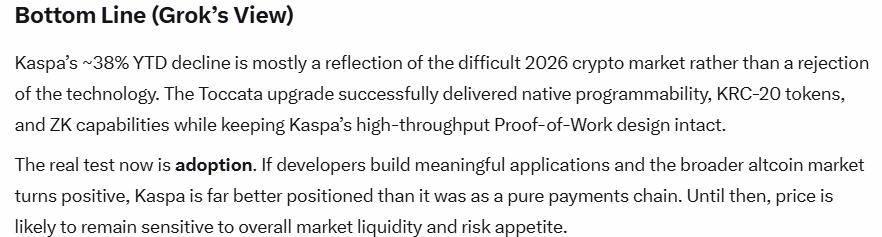
Grok’s View – Bottom Line
The AI analysis summary captured in the image frames the situation precisely:
“Kaspa’s ~38% YTD decline is mostly a reflection of the difficult 2026 crypto market rather than a rejection of the technology. The Toccata upgrade successfully delivered native programmability, KRC-20 tokens, and ZK capabilities while keeping Kaspa’s high-throughput Proof-of-Work design intact. The real test now is adoption. If developers build meaningful applications and the broader altcoin market turns positive, Kaspa is far better positioned than it was as a pure payments chain. Until then, price is likely to remain sensitive to overall market liquidity and risk appetite.”
This framing is accurate and useful. The -38% decline is primarily a macro and market structure story — not a Kaspa technology failure. Toccata delivered what it promised. The question now is whether the ecosystem can attract the developer activity and application adoption that would translate the technical upgrade into sustained on-chain demand.
Frequently Asked Questions (FAQ)
Why is Kaspa (KAS) down 38% year-to-dte in 2026?
Four converging factors: broader 2026 altcoin market weakness (mirroring Ethereum’s -38% YTD), post-Toccata upgrade sell-the-news profit taking, weak early KRC-20 ecosystem retention, and miner capitulation creating consistent daily selling pressure as hashrate declined from ~1.50 EH/s to ~0.30 EH/s.
What is the Toccata upgrade and when did it activate?
Toccata is Kaspa’s most significant hard fork — activating on June 30, 2026 — delivering native covenants, KRC-20 tokens, SilverScript programmability, ZK proof verification, and partitioned sequencing while keeping Kaspa’s UTXO-based BlockDAG PoW architecture intact.
What does Kaspa’s hashrate chart show?
A peak of approximately 1.50 EH/s in December 2024 declining to approximately 0.30 EH/s by mid-2026 — reflecting miner capitulation as KAS price declined below break-even for many operations, creating structural daily selling pressure from miners covering costs.
What is Grok’s assessment of Kaspa’s situation?
That the -38% YTD decline is “mostly a reflection of the difficult 2026 crypto market rather than a rejection of the technology” — with the real test being adoption: “If developers build meaningful applications and the broader altcoin market turns positive, Kaspa is far better positioned than it was as a pure payments chain.”
The opinions and market insights shared on CoinsProbe represent the views of individual authors based on prevailing market conditions at the time of publication. Cryptocurrency investments carry significant risk and volatility. Readers are encouraged to conduct their own research and seek professional financial advice before making investment decisions. CoinsProbe and its contributors do not accept responsibility for financial losses or decisions made based on published content.
CoinsProbe may publish sponsored articles, affiliate links, or promotional collaborations. All sponsored material is clearly labeled to maintain transparency with our audience. Our editorial decisions remain fully independent, and advertising partnerships do not influence reviews, rankings, or published opinions.
Since 2023, CoinsProbe has delivered reliable insights on cryptocurrency, blockchain, and digital assets. Our content is created by experienced researchers and analysts who follow strict editorial standards focused on accuracy, transparency, and credibility. Every article is carefully reviewed and verified using trusted sources and current market data. We provide unbiased analysis and timely updates covering everything from emerging crypto projects to major industry developments.