

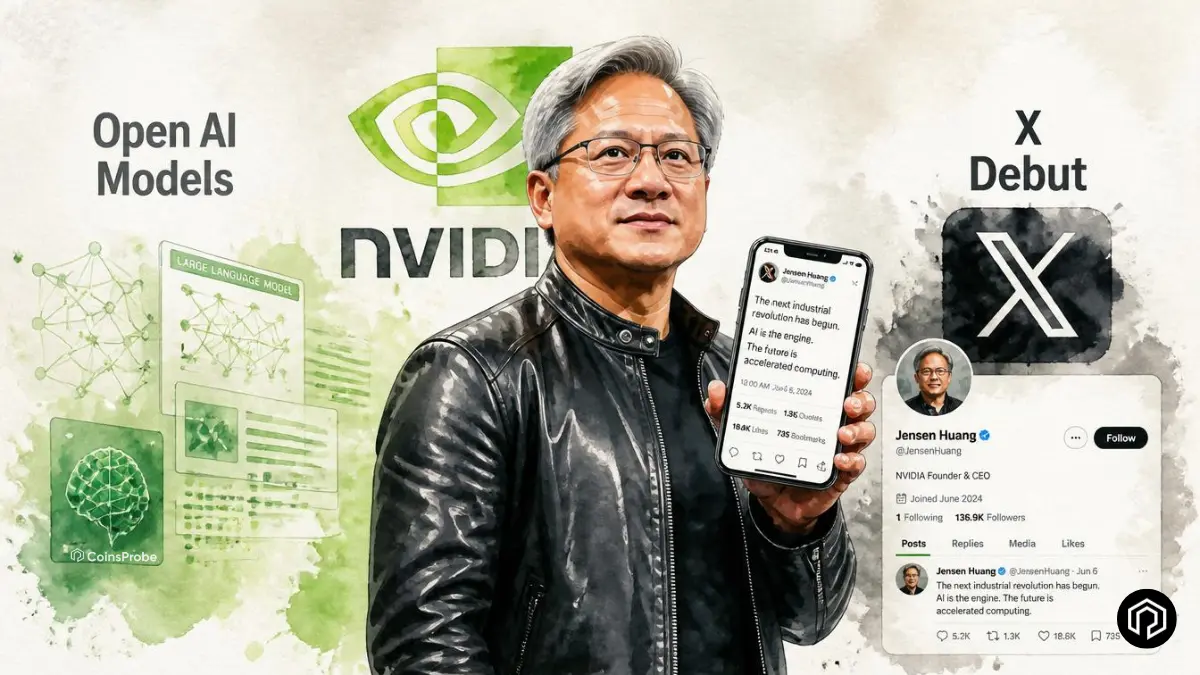
- NVIDIA CEO Jensen Huang made his first-ever X post, sharing a letter supporting open-weight AI models rather than announcing a new product.
- The letter was signed by Microsoft, Meta, IBM, Hugging Face, Mistral, Palantir, Dell, and many other leading AI companies.
- It argues that open-weight AI is critical for innovation, security, and maintaining US AI leadership.
Jensen Huang joining X and making an open AI advocacy letter his very first post is not a casual social media move. When the CEO of the company that powers the overwhelming majority of global AI infrastructure chooses his debut moment to take a public stance on one of Washington’s most contested AI policy debates — that is a deliberate, calculated signal about where the industry’s most powerful voice is positioning itself.
What Jensen Huang Said
In his debut post, Huang wrote:
“For my first post, I’m sharing a letter @NVIDIA signed on why open models matter. AI will transform every industry, power every company, and be built by every country. Open models strengthen safety and cybersecurity, accelerate innovation and diffusion, and enable sovereignty. The world needs both frontier closed models and frontier open models.”
Every word in that statement is deliberate. “Built by every country” is a sovereignty argument. “Strengthen safety and cybersecurity” directly addresses the most common criticism used to justify open-model restrictions. “The world needs both” is a diplomatic framing that avoids attacking closed-model providers while firmly establishing NVIDIA’s position in favour of open access.
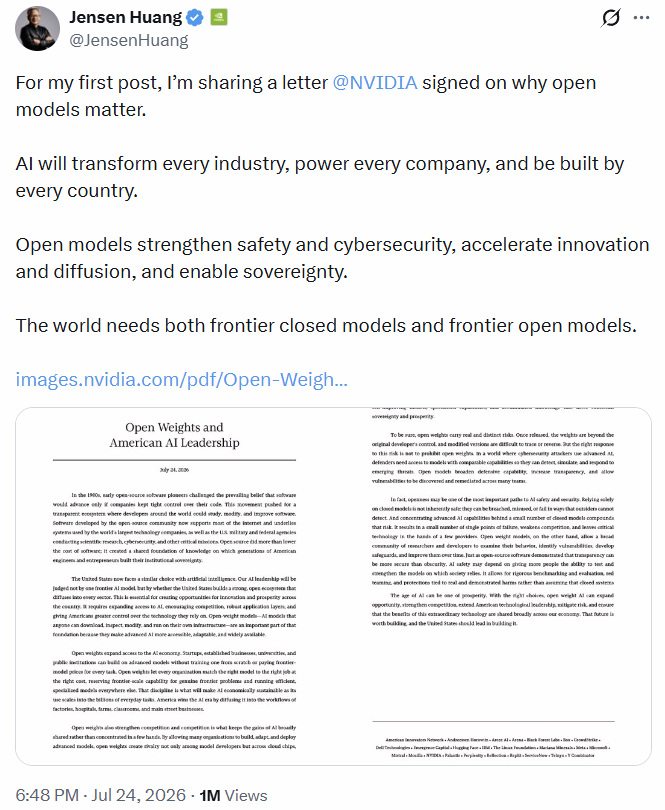
The Letter — “Open Weights and American AI Leadership”
The full letter — dated July 24, 2026 — lays out a comprehensive policy argument across six core themes:
The historical parallel:
Open-source software in the 1980s and 1990s created the shared foundation that powers the modern internet, US technology companies, and critical government systems globally. The letter argues open-weight AI models can play the same foundational role in the AI era — accessible infrastructure that enables an entire ecosystem to build on top of, rather than a proprietary stack controlled by a small number of companies.
Expanding access beyond frontier players:
Open weights allow startups, universities, hospitals, factories, and small businesses to deploy advanced AI without training models from scratch or paying frontier API prices for every inference task. This democratisation of access is framed as an economic and competitive imperative — keeping AI’s benefits from concentrating exclusively in the handful of companies with the compute budgets to build frontier closed models.
Competition and economic benefits:
Open models increase competition across every layer of the AI stack — model developers, cloud providers, chip manufacturers, and application builders. Greater competition drives down costs and spreads the economic gains of AI more broadly. For NVIDIA specifically, this argument is also strategically self-interested: more open-model developers means more GPU demand, not less.
Customer control and sovereignty:
Organisations that use open-weight models can inspect, modify, and run them on their own infrastructure — avoiding vendor lock-in and retaining ownership of the value they create with AI. This sovereignty argument is particularly relevant for governments and institutions outside the US who are increasingly cautious about depending entirely on US-controlled closed-model providers.
Safety and cybersecurity — the counterintuitive argument:
The most contested claim in the letter directly challenges the dominant closed-model safety narrative. The signatories argue that closed models create single points of failure — if one closed system has a vulnerability, it cannot be publicly examined and fixed. Open weights allow many independent teams to examine behaviour, red-team models, find vulnerabilities, and improve them — a distributed safety model rather than a centralised one.
The letter makes the additional point that in a world where attackers already have access to advanced AI, defenders need comparable tools — and restricting open weights would disadvantage defenders without meaningfully constraining well-resourced adversaries who can train or acquire models through other means.
Policy recommendations:
The letter calls on policymakers to expand access to compute, invest in shared datasets and tools, and avoid premature broad restrictions on open models that could stifle competition or push innovation overseas. It specifically addresses distillation — a common model-improvement technique — arguing it should not be confused with unlawful misappropriation, pushing back against potential regulatory overreach in that area.
The closing statement:
“The age of AI can be one of prosperity. With the right choices, open weight AI can expand opportunity, strengthen competition, extend American technological leadership, mitigate risk, and ensure that the benefits of this extraordinary technology are shared broadly across our economy. That future is worth building, and the United States should lead in building it.”
The Signatories — An Unusual Coalition
The breadth of the coalition behind this letter is as significant as its content. The signatories span a range of categories that rarely align so publicly:
Big Tech infrastructure: NVIDIA, Microsoft, Dell
Open-source AI leaders: Meta, Hugging Face, Mistral
Enterprise and cybersecurity: IBM, Palantir, CrowdStrike
Venture capital: Andreessen Horowitz, Y Combinator
This is not a coalition of companies that typically agree on everything — the presence of both Microsoft (which has significant investment in OpenAI, a closed-model provider) and Meta (which has championed open-source Llama models) alongside cybersecurity firms and VC funds signals genuine, cross-sector consensus rather than a narrow lobbying effort by a single company type.
Why This Matters for Crypto and Decentralised AI
The open-weight AI debate has direct and significant implications for the crypto and decentralised AI sector — which has been one of 2026’s most active investment narratives.
Bittensor (TAO) and decentralised AI networks:
The entire premise of Bittensor — a decentralised network of AI models competing through an incentive layer — depends on the availability of open-weight models that can be deployed, fine-tuned, and run by independent validators. A regulatory environment that restricts open-weight models would directly threaten the operational model of every decentralised AI network.
Virtuals Protocol and AI agents:
As we covered in our Virtuals Protocol fee and Robinhood Chain article — AI agent protocols rely on accessible model infrastructure to power autonomous agents without frontier API costs per inference. Open-weight models are the economic foundation that makes AI agent protocols viable at scale — a regulatory threat to open weights is a regulatory threat to the AI agent sector broadly.
The broader decentralised AI narrative:
The 2026 theme of decentralised AI — projects providing open, permissionless access to AI compute, inference, and model deployment — is ideologically and economically aligned with the open-weight position this letter articulates. An industry letter of this scale, backed by NVIDIA and co-signed by dozens of leading institutions, provides the most credible mainstream validation the open AI narrative has received to date.
Why Jensen Huang’s Debut Post Matters Beyond the Content
The symbolism of Huang’s X debut cannot be overstated. NVIDIA is the company that provides the computational infrastructure for virtually every major AI model — closed and open alike. When Huang chooses his first-ever social media post to take a clear public stance on open weights rather than announce a product or financial result, it signals that NVIDIA has decided this policy debate is important enough to directly engage rather than remain neutral.
For Washington’s ongoing AI regulatory debate — which has been weighing restrictions on open-weight models on national security grounds — having NVIDIA’s voice explicitly on the pro-open side adds institutional weight that no other company could match. The company that sells the GPUs that train both open and closed models is publicly arguing that open models are essential to American AI leadership.
Bottom Line
Jensen Huang’s X debut — choosing an open AI advocacy letter as his first post — is a significant moment in the AI policy debate that will directly shape the regulatory environment for AI development, crypto, and decentralised infrastructure over the coming years. The coalition of signatories represents one of the broadest cross-sector consensus statements the AI industry has produced, and NVIDIA’s explicit alignment with open weights adds institutional credibility that the open-source AI community has sought for years.
For crypto investors tracking the decentralised AI narrative — the regulatory direction this letter is pushing toward is one that supports rather than threatens the open, permissionless AI infrastructure that underpins projects like Bittensor, Virtuals Protocol, and the broader AI agent ecosystem.
Frequently Asked Questions (FAQ)
What was Jensen Huang’s first post on X?
Huang shared a major industry letter titled “Open Weights and American AI Leadership” — co-signed by NVIDIA, Microsoft, Meta, IBM, Hugging Face, Palantir, CrowdStrike, Andreessen Horowitz, and dozens more — arguing that open-weight AI models are essential to American AI leadership.
The opinions and market insights shared on CoinsProbe represent the views of individual authors based on prevailing market conditions at the time of publication. Cryptocurrency investments carry significant risk and volatility. Readers are encouraged to conduct their own research and seek professional financial advice before making investment decisions. CoinsProbe and its contributors do not accept responsibility for financial losses or decisions made based on published content.
CoinsProbe may publish sponsored articles, affiliate links, or promotional collaborations. All sponsored material is clearly labeled to maintain transparency with our audience. Our editorial decisions remain fully independent, and advertising partnerships do not influence reviews, rankings, or published opinions.
Since 2023, CoinsProbe has delivered reliable insights on cryptocurrency, blockchain, and digital assets. Our content is created by experienced researchers and analysts who follow strict editorial standards focused on accuracy, transparency, and credibility. Every article is carefully reviewed and verified using trusted sources and current market data. We provide unbiased analysis and timely updates covering everything from emerging crypto projects to major industry developments.