
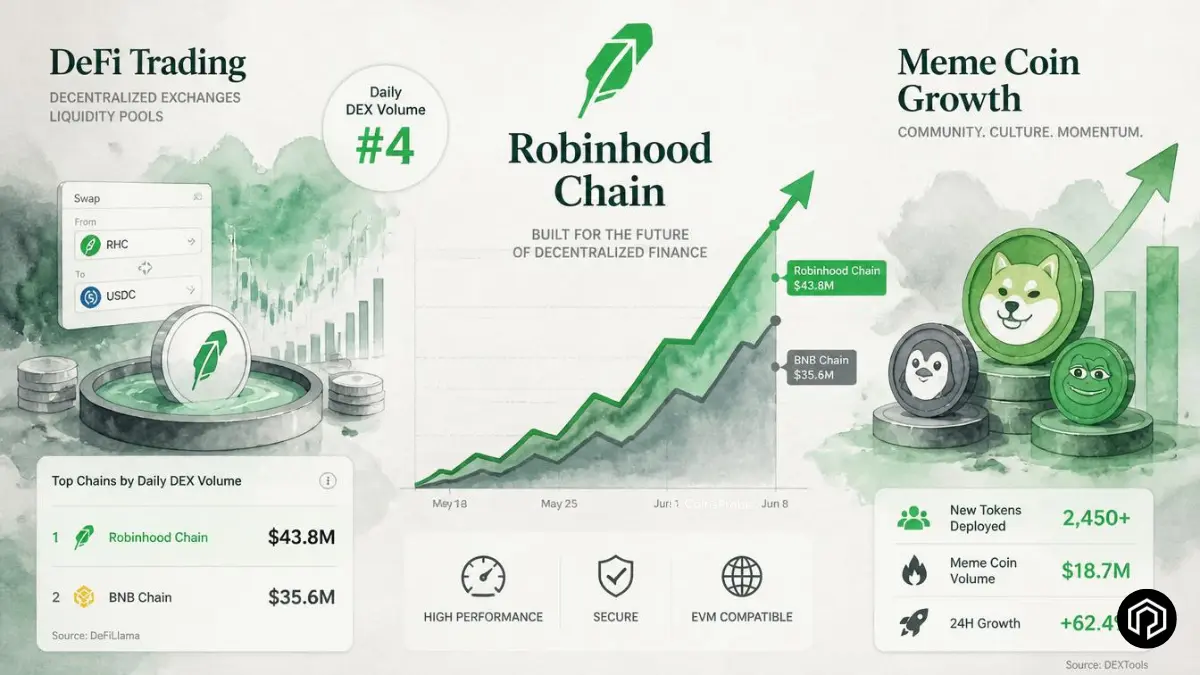
- Robinhood Chain has surged to #4 globally in 24-hour DEX volume, overtaking BNB Chain just one week after launch.
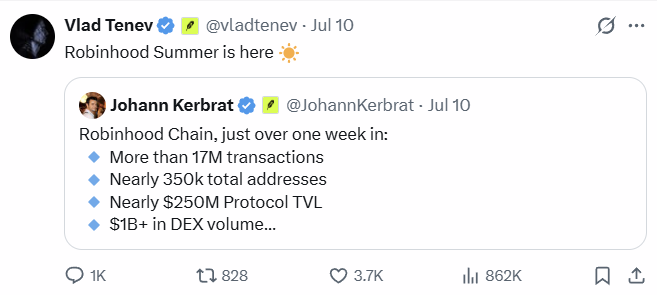
- The network has already recorded $1B+ in DEX volume, 17M+ transactions, and ~$250M in TVL.
- Memecoins, led by $CASHCAT, have been the biggest growth driver, fueling massive on-chain activity.
- CEO Vlad Tenev declared "Robinhood Summer is here" as the chain's explosive debut exceeded expectations.
New blockchains typically spend months or years building toward the kind of metrics Robinhood Chain has produced in seven days. The combination of a major consumer brand, ultra-fast 100-millisecond block times, and an unexpected meme coin explosion has produced one of the most dramatic first-week performances any new chain has generated in recent memory.
Robinhood Chain — First Week in Numbers
| Metric | Data |
|---|---|
| Launch date | July 1, 2026 |
| Chain type | Permissionless Arbitrum Layer-2 |
| Gas token | ETH |
| Block time | 100 milliseconds |
| Cumulative DEX volume (week 1) | $1 billion+ |
| Total transactions | 17 million+ |
| Active addresses | ~350,000 |
| TVL | ~$250 million |
The chain uses ETH as its gas token and is optimized for onchain finance, including tokenized real-world assets such as NVIDIA and Google shares (available outside the U.S.).
Current DEX Volume Rankings — Where Robinhood Chain Sits
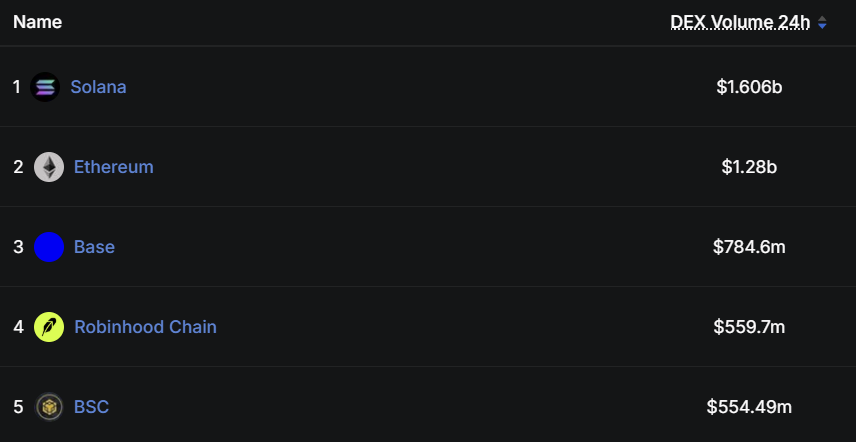
According to the latest data from defillama‘s 24-hour DEX volume ranking, Robinhood Chain now sits in 4th place, outperforming Binance Smart Chain (BSC). The current ranking is as follows: Solana leads with $1.606 billion, followed by Ethereum at $1.28 billion, Base with $784.6 million, Robinhood Chain at $559.7 million, and BSC at $554.49 million.
To contextualise how extraordinary this is: Binance Smart Chain launched in September 2020 and spent years building toward its current position as one of the world’s most active trading chains. Robinhood Chain surpassed it in seven days — driven by a retail frenzy that even Robinhood’s own CEO did not fully anticipate at launch.
How It Happened — The Meme Coin Explosion
Robinhood Chain was built and positioned as serious financial infrastructure — optimised for tokenized real-world assets including NVIDIA and Google shares available outside the US, and designed for institutional-grade onchain finance.
What actually drove its first-week numbers was something different: meme coins.
As we covered in detail in our $CASHCAT $200M market cap article — $CASHCAT emerged as the chain’s dominant memecoin narrative from the earliest days, climbing from a negligible starting cap to $200 million while delivering +3,759% in 7 days. Its narrative hook — a name reportedly connected to an early Robinhood branding idea that predates the company’s current name — gave it cultural weight beyond a typical community memecoin.
Trading concentrated primarily on Uniswap deployed on Robinhood Chain — the default DEX for the chain’s early trading activity — with the meme coin frenzy driving the $886 million single-day DEX volume we documented at the peak of $CASHCAT’s run. That single-day figure alone would have placed Robinhood Chain in the top five chains globally on that day.
The pattern mirrors what Solana experienced during its own peak memecoin periods — a new chain generating explosive early volume through retail-driven speculative trading, attracting liquidity and users who then provide the foundation for more serious DeFi development subsequently.
Vlad Tenev’s Meme Pivot — “Robinhood Summer Is Here”
Perhaps the most symbolically significant moment of Robinhood Chain’s first week was Vlad Tenev’s own public reaction.
Having initially positioned the chain for institutional use cases and at one point suggesting memes were a “dead end” — Tenev publicly reversed course on July 8, 2026, stating the chain “works great for memes too” before celebrating the broader debut with:
“Robinhood Summer is here.”
The CEO of a major publicly traded financial services company embracing his chain’s meme coin activity — rather than distancing from it — is a notably unusual public position in the financial services world. It reflects both the genuine scale of the activity the chain generated and a pragmatic recognition that retail engagement, whatever form it takes, is building the user base and liquidity that Robinhood Chain’s longer-term institutional use cases will eventually depend on.
What Makes Robinhood Chain Different — The Technical Foundation
Beyond the meme narrative, Robinhood Chain has genuine technical differentiation that gives it a more credible long-term foundation than purely speculative chains:
100-millisecond block times — Among the fastest settlement speeds of any EVM-compatible chain currently operating — important for both retail trading experiences and the institutional trading applications the chain was originally designed to serve.
Arbitrum Layer-2 architecture — Inheriting Ethereum’s security while delivering significantly faster and cheaper transactions than Ethereum mainnet.
ETH as gas token — Aligning the chain with Ethereum’s ecosystem rather than requiring a proprietary gas token, reducing friction for existing Ethereum users and developers.
Tokenized RWA focus — NVIDIA and Google shares available as tokenized assets on-chain for non-US users represent the institutional use case that Robinhood Chain was specifically built to enable — a genuine product differentiation beyond the meme coin activity currently driving volume.
The Bigger Picture — What This Week Demonstrates
Robinhood Chain’s first-week performance answers a question the crypto industry has been debating: does a major consumer brand launching a blockchain actually matter?
The answer is yes — but not always in the way expected. The Robinhood brand did not drive institutional adoption of tokenized stocks in week one. It drove retail FOMO into meme coins — which created the volume, users, and liquidity that makes the chain’s institutional use cases viable to build on top of.
This is actually a well-documented pattern in blockchain adoption: speculative retail activity creates the economic baseline that attracts serious developers and institutional participants subsequently. Solana’s meme coin period produced exactly this dynamic — the capital and attention that flowed in through speculation eventually supported a much broader ecosystem.
Whether Robinhood Chain follows that trajectory depends on whether the current retail energy translates into sustained developer activity, product development, and institutional adoption of the tokenized RWA capabilities the chain was originally designed for.
Bottom Line
Robinhood Chain surpassing Binance Smart Chain in 24-hour DEX volume in its first week of operation is one of the most striking new chain debut performances in recent crypto history. The combination of Robinhood’s consumer brand, 100-millisecond block time, and an explosive $CASHCAT-led meme coin narrative produced metrics that established chains spent years building toward.
Vlad Tenev’s “Robinhood Summer is here” declaration captures the mood — but the chain’s actual long-term significance will be determined by what comes after the meme coin phase: whether the tokenized RWA capabilities, institutional product development, and DeFi infrastructure can sustain and grow the user base that the first week’s speculation attracted.
Week one belongs to the memes. Whether week 52 belongs to institutional finance on-chain — that is the question Robinhood Chain now has to answer.
Frequently Asked Questions
What is Robinhood Chain?
A permissionless Arbitrum Layer-2 blockchain launched by Robinhood on July 1, 2026 — using ETH as its gas token, featuring 100-millisecond block times, and originally designed for tokenized real-world assets and institutional onchain finance.
How did Robinhood Chain perform in its first week?
Over $1 billion in cumulative DEX volume, 17 million+ transactions, ~350,000 active addresses, and ~$250 million in TVL — placing it #4 globally by 24-hour DEX volume and above Binance Smart Chain in just seven days.
What drove Robinhood Chain’s first-week volume?
Primarily meme coin activity — led by $CASHCAT which surged +3,759% in 7 days to a $200M market cap — with trading concentrated on Uniswap deployed on the chain.
The opinions and market insights shared on CoinsProbe represent the views of individual authors based on prevailing market conditions at the time of publication. Cryptocurrency investments carry significant risk and volatility. Readers are encouraged to conduct their own research and seek professional financial advice before making investment decisions. CoinsProbe and its contributors do not accept responsibility for financial losses or decisions made based on published content.
CoinsProbe may publish sponsored articles, affiliate links, or promotional collaborations. All sponsored material is clearly labeled to maintain transparency with our audience. Our editorial decisions remain fully independent, and advertising partnerships do not influence reviews, rankings, or published opinions.
Since 2023, CoinsProbe has delivered reliable insights on cryptocurrency, blockchain, and digital assets. Our content is created by experienced researchers and analysts who follow strict editorial standards focused on accuracy, transparency, and credibility. Every article is carefully reviewed and verified using trusted sources and current market data. We provide unbiased analysis and timely updates covering everything from emerging crypto projects to major industry developments.