
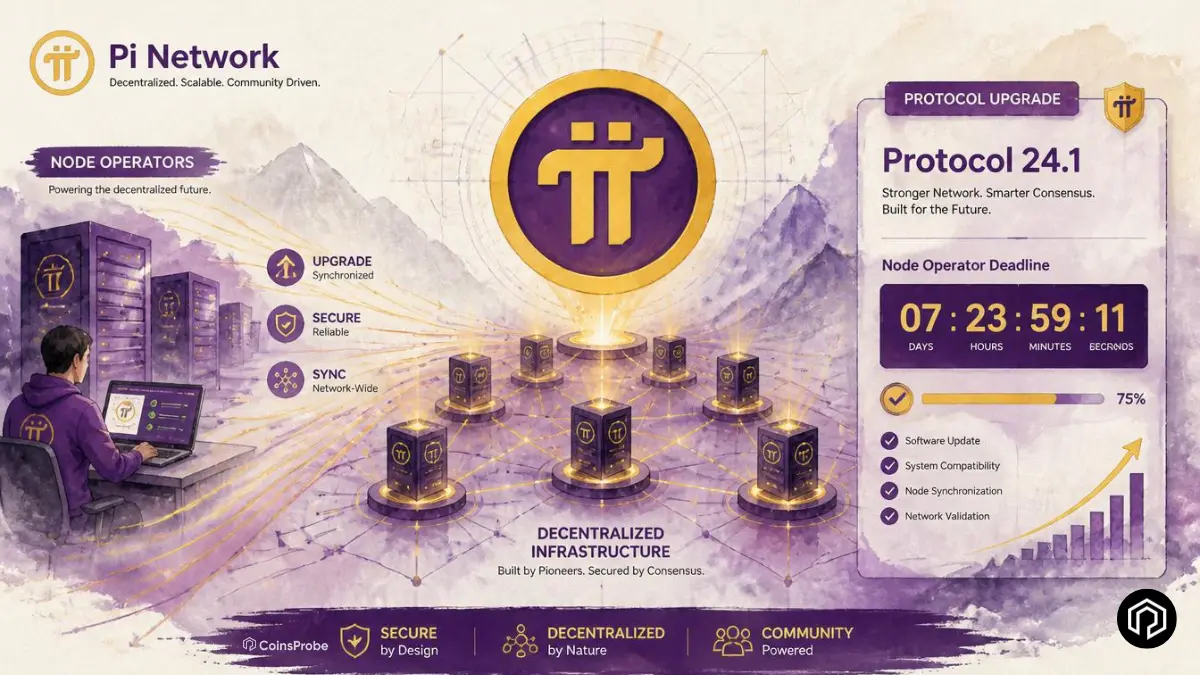

- The Protocol 23.0 → 24.1 upgrade is now active — with all nodes required to complete the migration by June 2, 2026.
- The upgrade is described as a very quick migration — with internal data migrations completing in under 5 minutes — significantly faster than the complex v23.0 upgrade.
- The Docker image for this upgrade is: pinetwork/pi-node-docker:organization_mainnet-v1.0-p24.1.0
- Node operators must NOT start Protocol 25.1 or 26.0 upgrades yet — these remain locked until officially activated by the Pi Core Team.
Pi Network’s sequential protocol upgrade sequence continues. Following the successful completion of the Protocol 23.0 upgrade — which completed the most complex infrastructure overhaul in Pi’s history, simultaneously upgrading the protocol, operating system from Ubuntu 20 to 24, and database from PostgreSQL 12 to 16 — the Protocol 24.1 upgrade is now active with a hard deadline of June 2, 2026.
As we covered in our v23 upgrade completion article, most major Mainnet nodes successfully completed the v23 migration — and the network is now progressing on schedule toward v26 as the final destination in the current upgrade sequence.
The good news for node operators: after the complexity of v23 — which required simultaneous OS, database, and protocol migrations with extended startup times — v24.1 is a significantly more straightforward upgrade.
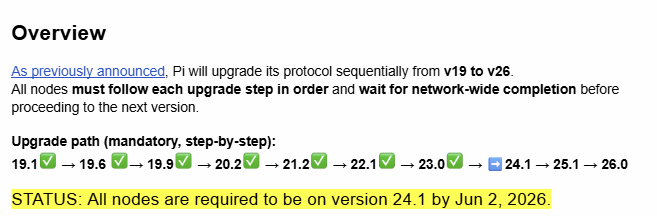
The Full Upgrade Path — Where We Are Now
Pi Network’s protocol upgrade sequence runs sequentially from v19 to v26 — with each step mandatory and each requiring network-wide completion before the next begins:
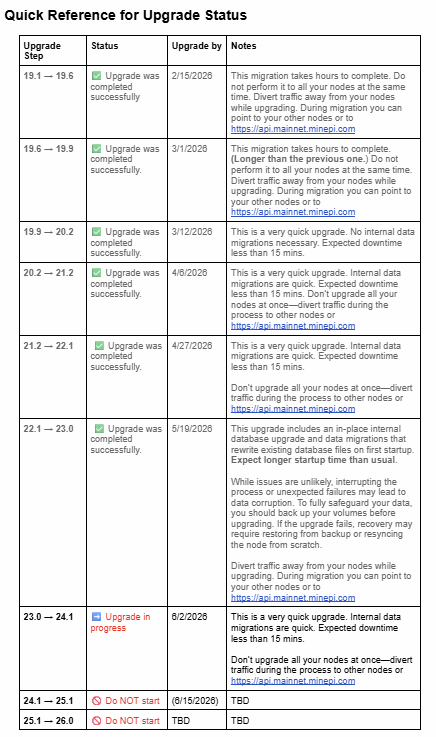
Six steps completed. One active. Two locked. The network is approximately 75% of the way through its full v19-to-v26 upgrade sequence — with v26 representing the fully upgraded production infrastructure that supports Pi’s growing ecosystem and long-term scalability goals.
What the 23.0 → 24.1 Upgrade Involves
The v24.1 upgrade is characterised by its relative simplicity compared to the v23.0 milestone — which the Pi Core Team described as one of the most challenging upgrades in Pi’s history.
Key characteristics of this upgrade:
Very quick migration — Internal data migrations are quick with expected downtime under 5 minutes in most cases. In rare cases restarts may take slightly longer — but the extended startup times that characterised v23.0 are not expected here.
Standard internal data migration — Unlike v23.0 which involved rewriting existing database files and required backup precautions due to corruption risk, v24.1 is a straightforward internal migration without the same level of complexity or risk.
Sequential completion required — As with every step in the upgrade sequence, nodes must complete v24.1 before the network can proceed to v25.1. All nodes running on v23.0 need to upgrade — partial completion delays the network’s overall progress toward v26.
How to Upgrade — Step by Step
Docker Image (Primary Method)
Docker Image:
pinetwork/pi-node-docker:organization_mainnet-v1.0-p24.1.0Release Notes: https://github.com/PiCoreTeam/pi-node-docker/releases/tag/organization_mainnet-v1.0-p24.1.0
For Docker users — update your docker-compose.yml:
yaml
image: pinetwork/pi-node-docker:organization_mainnet-v1.0-p24.1.0Then run:
bash
docker-compose up -d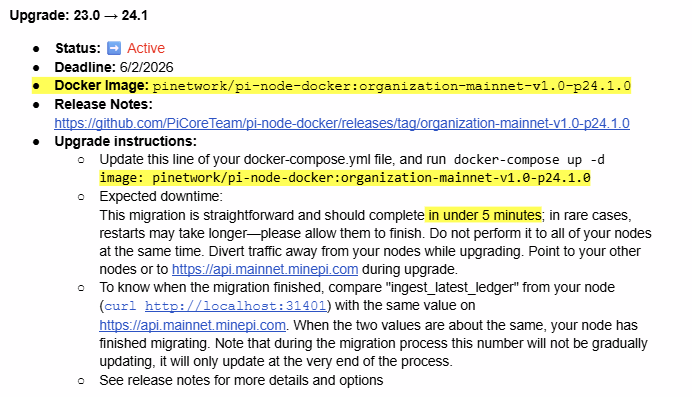
To confirm migration is complete:
Compare the ingest_latest_ledger value from your node:
bash
curl http://localhost:31401Against the value on https://api.mainnet.minepi.com
When both values are approximately equal — your node has finished migrating. Note: this number will not update gradually during migration — it only updates at the very end of the process. Do not interpret a static number during migration as a failure.
Pi Desktop (Windows / macOS)
Restart your Pi Node via Pi Desktop — the upgrade triggers automatically with the latest release.
Linux Node CLI
bash
pi-node update-protocolMonitor with:
bash
watch pi-node statusComplete when status shows “Synced”.
Critical Rules for This Upgrade
Do NOT upgrade all nodes at once — Stagger your upgrades. Divert traffic away from nodes currently upgrading — point to your other nodes or to https://api.mainnet.minepi.com during the process.
Do NOT start 25.1 or 26.0 — These upgrade steps are locked and must not be started until the Pi Core Team officially activates them. The upgrade table clearly marks these as “Do NOT start”.
June 2 is a hard deadline — Nodes that miss the deadline risk disconnection from Pi Mainnet and may require a full resync to rejoin the network. The relatively short migration time means there is no reason to delay.
Monitor the migration endpoint — Use the ingest_latest_ledger comparison method to confirm your migration has fully completed — do not assume completion based on a node restart alone.
Why This Upgrade Matters — The Bigger Picture
Each sequential upgrade in Pi’s v19-to-v26 path is building toward the same destination: a fully upgraded, production-ready Layer-1 blockchain capable of supporting Pi’s 18.1 million+ KYC-verified Pioneers and the broader ecosystem the Pi Core Team is building toward.
Protocol 23 aligns Pi with Stellar Core v23 — which includes the technical foundation for future ecosystem capabilities including potential dApp and smart contract support. However, official activation of smart contracts and dApps on Pi Mainnet has not yet been confirmed by the Pi Core Team. Each upgrade step in the sequence is building the infrastructure foundation that will support these capabilities when they are officially enabled.
The protocol upgrades are not happening in isolation — they are being built alongside a rapidly expanding ecosystem of partnerships and access points. As we covered in our OKX US market expansion article, OKX has opened Pi access to millions of American users for the first time — bringing one of the world’s most regulated and valuable crypto markets into the Pi ecosystem at exactly the moment the infrastructure is maturing. And as we detailed in our Banxa partnership spotlight, Banxa’s embedded fiat on-ramp — live inside the Pi Wallet since April 2025 — gives Pioneers a direct path to buy Pi using credit cards, bank transfers, and Apple Pay without leaving the app.
As we covered in our Pi App Studio vibe coding update, the developer and builder community is expanding — with AI-assisted app creation accessible through the new App Studio workflows. And as confirmed in the April 2026 Network Update, Pi’s verified user base continues to grow month over month — providing the community foundation that makes each infrastructure upgrade increasingly meaningful.
Every protocol upgrade step completed moves the network closer to the infrastructure state that supports this ecosystem at full scale. The v24.1 upgrade is not the destination — it is the next necessary step on the path. With v25.1 and v26.0 still ahead, completing v24.1 on time keeps the network on schedule for its full infrastructure maturity.
Bottom Line
The Protocol 24.1 upgrade is active, the migration is quick, and the deadline is June 2, 2026. After the complexity of v23.0 — this is a straightforward step that node operators should complete as early as possible rather than waiting until the deadline. Update your Docker image to pinetwork/pi-node-docker:organization_mainnet-v1.0-p24.1.0, run the upgrade, confirm migration completion via the ledger endpoint, and keep the network moving toward v26.
The upgrade sequence is 75% complete. The infrastructure foundation is being built step by step. The next milestones are close.
Frequently Asked Questions (FAQ)
What is the Pi Network Protocol 24.1 upgrade?
The next mandatory step in Pi’s sequential v19-to-v26 upgrade sequence — migrating nodes from Protocol 23.0 to 24.1. It is a quick internal data migration with expected completion in under 5 minutes, active now with a June 2, 2026 deadline.
What is the Docker image for the v24.1 upgrade?
pinetwork/pi-node-docker:organization_mainnet-v1.0-p24.1.0 — update this in your docker-compose.yml and run docker-compose up -d to execute the upgrade.
How long does the v24.1 migration take?
Under 5 minutes in most cases — significantly faster than the v23.0 upgrade which required extended database reprocessing time.
Can I start the v25.1 or v26.0 upgrade after completing v24.1?
No — both remain locked and marked “Do NOT start” until officially activated by the Pi Core Team. Always wait for the official activation signal before proceeding to the next step.
How do I confirm my node has finished migrating?
Compare the ingest_latest_ledger value from your node (curl http://localhost:31401) with the value on https://api.mainnet.minepi.com. When both values match, migration is complete.
Are smart contracts and dApps now live on Pi Mainnet?
No — the Pi Core Team has not officially confirmed the activation of smart contracts or dApps on Pi Mainnet. Protocol 23 aligns Pi with Stellar Core v23 which includes the technical foundation for these capabilities — but official activation has not yet been announced.
The opinions and market insights shared on CoinsProbe represent the views of individual authors based on prevailing market conditions at the time of publication. Cryptocurrency investments carry significant risk and volatility. Readers are encouraged to conduct their own research and seek professional financial advice before making investment decisions. CoinsProbe and its contributors do not accept responsibility for financial losses or decisions made based on published content.
CoinsProbe may publish sponsored articles, affiliate links, or promotional collaborations. All sponsored material is clearly labeled to maintain transparency with our audience. Our editorial decisions remain fully independent, and advertising partnerships do not influence reviews, rankings, or published opinions.
Since 2023, CoinsProbe has delivered reliable insights on cryptocurrency, blockchain, and digital assets. Our content is created by experienced researchers and analysts who follow strict editorial standards focused on accuracy, transparency, and credibility. Every article is carefully reviewed and verified using trusted sources and current market data. We provide unbiased analysis and timely updates covering everything from emerging crypto projects to major industry developments.