
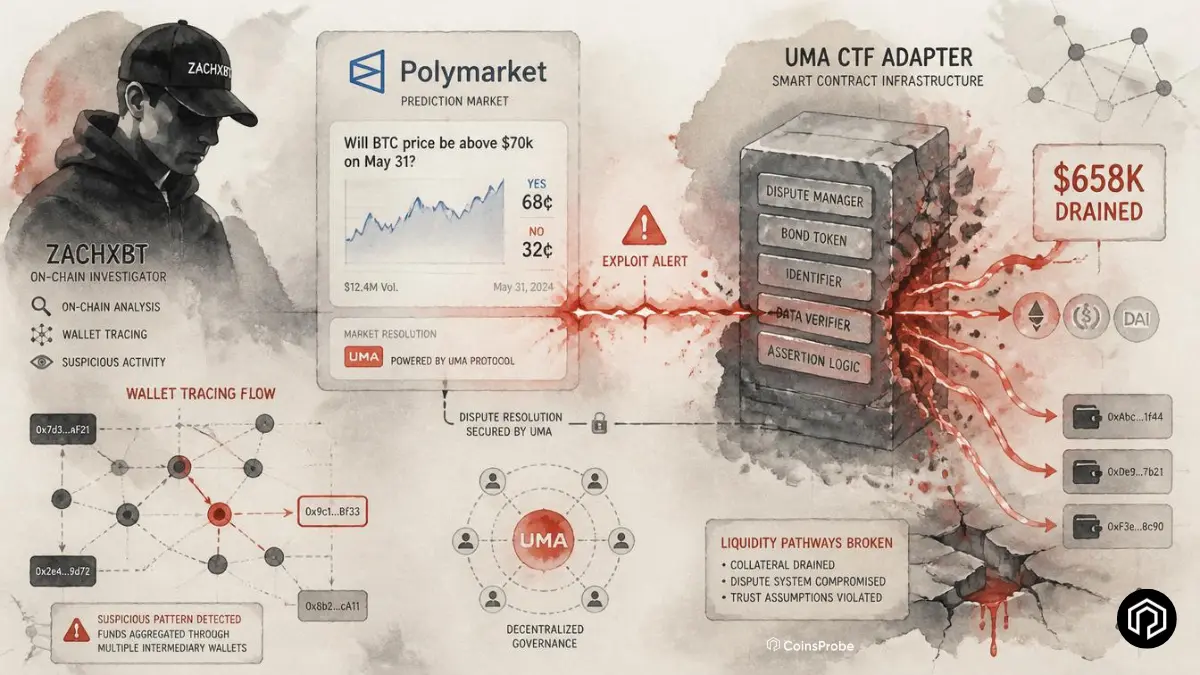
- On-chain investigator ZachXBT has flagged a suspected attack on Polymarket's UMA CTF Adapter contract on Polygon — with losses currently estimated at $520,000+, with some community reports pushing the figure to approximately $658K.
- The attacker address 0x8F98...9B91 was observed repeatedly draining approximately 5,000 POL every 30 seconds from the adapter system — with stolen funds split across 15+ wallets and routed through mixers and swap services including ChangeNOW.
- Community sources suggest the attack may have involved a compromised old private key rather than a fresh smart contract vulnerability.
- Polymarket has not yet issued an official statement — but community sources indicate main user deposits and active market liquidity remain unaffected. The exploited contracts are part of the backend resolution infrastructure, not primary user-facing vaults.
- 🔄 UPDATE: Polymarket VP of Engineering has confirmed no contracts were exploited — the incident involved a 6-year-old compromised private key in internal top-up config — now rotated and all PKs migrating to KMS keys.
UPDATE — Official Clarification from Polymarket VP of Engineering
Polymarket’s VP of Engineering, Def Josh, has issued an official statement confirming:
“No Polymarket or UMA contracts have been exploited. All user funds are safe, and using Polymarket.com is safe — business as usual. We had a 6-year-old private key that was compromised. This was in the internal top-up config, which is why funds were being sent to it. We have rotated this key, revoked all prod permissions and are moving all PKs to KMS keys from now on.”
Key takeaways from the official clarification:
- No smart contracts exploited — neither Polymarket nor UMA contracts were compromised
- All user funds are safe — Polymarket.com is safe to use normally
- Root cause confirmed — a 6-year-old private key in the internal top-up config was compromised — not a contract vulnerability
- Fully remediated — the key has been rotated, all production permissions revoked, and all private keys are being migrated to KMS (Key Management Service) keys
What this means: The incident was not a smart contract exploit — it was a private key compromise affecting an internal configuration wallet. The attacker exploited access to an old key that was still receiving automatic top-up transfers — draining those funds as they arrived. The fix is complete and the underlying infrastructure is secure.
Polymarket — the world’s largest decentralised prediction market — is dealing with a significant security incident. On May 22, 2026, on-chain investigator ZachXBT raised the alarm about a suspected attack targeting Polymarket’s UMA CTF Adapter contract deployed on the Polygon chain — an exploit that has drained an estimated $520,000 to $658,000 from the platform’s backend resolution infrastructure.
The incident is developing rapidly. ZachXBT and on-chain analysts are actively tracking the attacker’s movements, Polymarket’s team is reportedly investigating, and the community is monitoring whether the draining activity — which appeared to have slowed or stopped in the 20–30 minutes prior to publication — has fully ceased or may resume.
What Happened — The Attack Breakdown
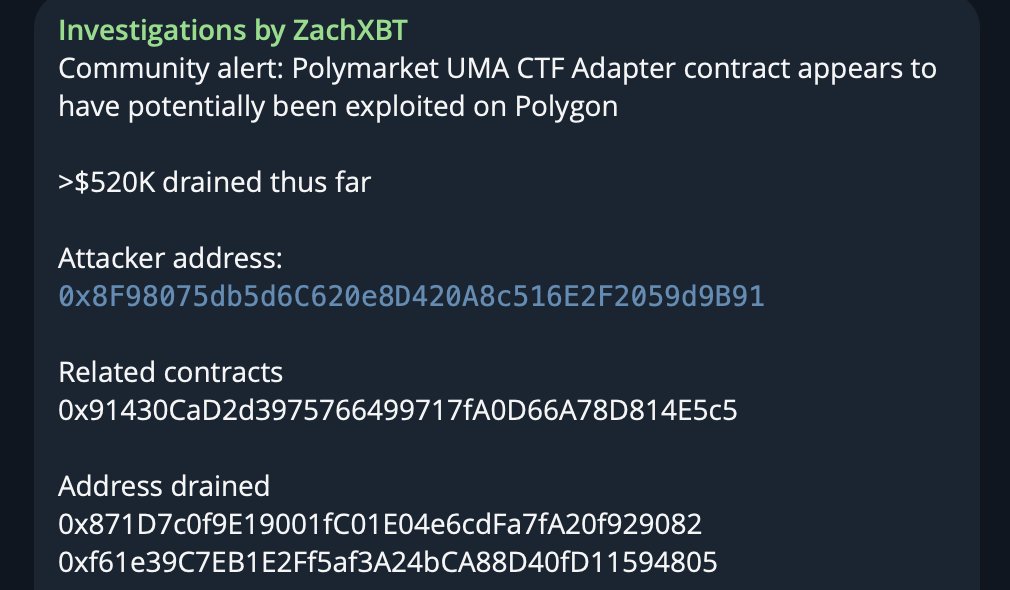
According to ZachXBT’s community alert and on-chain data, the attacker systematically drained funds from contracts associated with Polymarket’s resolution infrastructure:
Attacker address: 0x8F98075db5d6C620e8D420A8c516E2F2059d9B91
Affected and drained contracts:
0x871D7c0f9E19001fC01E04e6cdFa7fA20f9290820x91430CaD2d3975766499717fA0D66A78D814E5c50xf61e39C7EB1E2Ff5af3A24bCA88D40fD11594805
Stolen funds breakdown (community estimates):
- ~$458,000 in USDC
- ~$199,700 in POL
- Total: approximately $658K
The attack pattern — On-chain observers reported the attacker pulling approximately 5,000 POL every 30 seconds from the adapter system in a systematic and automated fashion — suggesting a scripted exploitation rather than a manual operation.
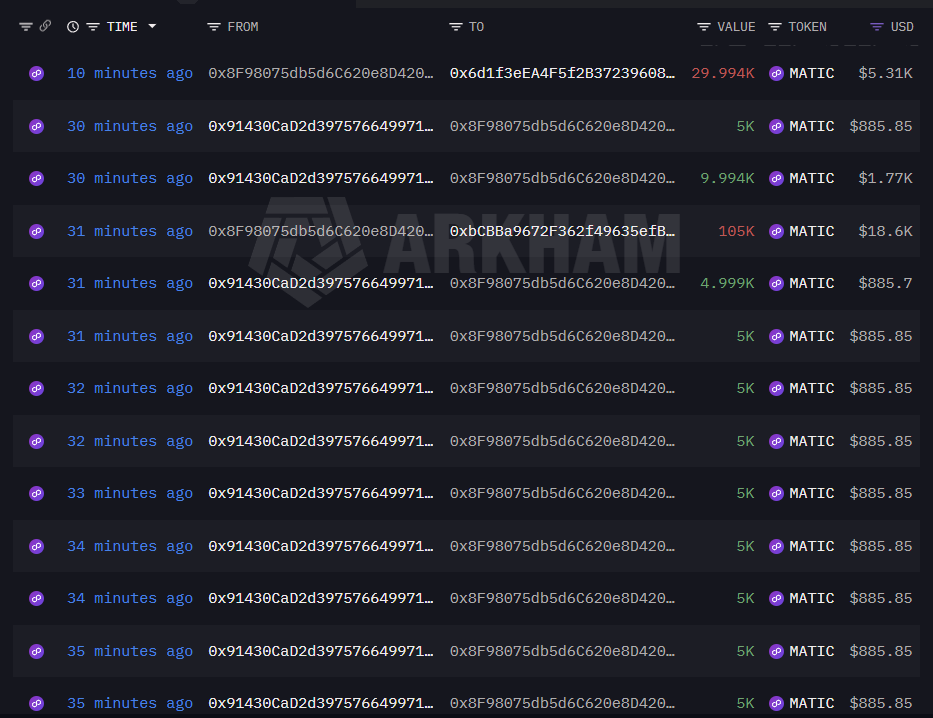
Fund dispersal — Stolen funds were subsequently split across 15+ wallet addresses — a classic dispersion technique designed to complicate tracking. Portions were routed through mixers and swap services including ChangeNOW in an apparent attempt to obscure the trail and complicate asset recovery.
Suspected vector — Community updates suggest the attack may have involved a compromised old private key associated with the adapter contracts — rather than a newly discovered smart contract vulnerability in the current codebase. If confirmed, this would point to a key management failure rather than a protocol bug — a distinction that matters for how the incident is assessed and remediated.
What Is the UMA CTF Adapter — Why It Was Targeted
To understand the significance of this exploit, it helps to understand what the UMA CTF Adapter actually does within Polymarket’s infrastructure.
Polymarket is a blockchain-based prediction market where users trade on the outcomes of real-world events — elections, crypto prices, sports results, news events — using USDC as the base currency. The platform relies on the Conditional Tokens Framework (CTF) for market mechanics and integrates UMA’s Optimistic Oracle for dispute resolution and final settlement.
The UMA CTF Adapter is the critical bridge between these two systems — fetching resolution data from UMA’s Optimistic Oracle and using it to resolve the CTF conditions that determine how markets settle and how winnings are distributed. It is deployed on Polygon and has been open-sourced by the Polymarket team.
In short: the adapter is not where user trading funds sit — but it is the infrastructure layer that determines how markets resolve. Exploiting it represents an attack on the integrity of Polymarket’s resolution mechanism rather than a direct theft from user deposits — which is why community sources are indicating that main user funds remain unaffected while the backend system has been compromised.
Is This the First Polymarket Security Incident?
This is not the first time Polymarket’s resolution infrastructure has come under scrutiny — though today’s incident appears operationally distinct from prior events.
In early 2025, Polymarket faced a high-profile UMA governance attack orchestrated by a large token holder known as “BornTooLate.eth” — who accumulated sufficient UMA governance power to influence the outcome resolution of a politically sensitive prediction market. That incident was a governance manipulation attack — exploiting the economics of UMA’s optimistic oracle rather than directly draining funds.
Today’s incident is categorically different — it is a direct fund drainage from adapter contracts, not a governance manipulation play. The attacker’s goal appears to have been financial extraction rather than outcome manipulation — making it a more traditional DeFi exploit than the 2025 governance attack.
Current Status — What Is Known
| Item | Status |
|---|---|
| Draining activity | Appears slowed |
| User deposits | Community sources indicate unaffected |
| Active market liquidity | Community sources indicate unaffected |
| Attacker funds | Split across 15+ wallets — being tracked |
| Polymarket statement | Not yet issued |
| Investigation | ZachXBT + on-chain analysts actively tracking |
The situation remains fluid. Polymarket has not issued an official statement as of publication — and the full scope of the exploit, the confirmed attack vector, and whether any additional contracts are at risk will not be known until the team completes its investigation.
Why This Matters Beyond Polymarket
This incident carries implications that extend well beyond Polymarket itself — for prediction markets as a sector and for DeFi infrastructure security broadly.
Prediction markets are at peak visibility — 2025–2026 has seen explosive growth in prediction market usage, particularly around major global events. Polymarket’s dominance makes any security incident involving its infrastructure a sector-wide news event. As we covered in our HIP-4 prediction markets launch, Hyperliquid’s binary prediction market launch specifically targeted Polymarket’s user base — and incidents like this will only accelerate the competitive pressure.
Oracle and adapter security is underappreciated — The exploit targets the resolution layer rather than the trading layer — a category of infrastructure risk that receives significantly less security attention than primary smart contracts despite being equally critical to platform integrity.
Legacy key management — If the compromised private key vector is confirmed, it highlights one of the most persistent and underaddressed risks in DeFi: old keys associated with contracts that remain active and hold or control value long after the original deployment context has changed.
The irony — Prediction markets are already seeing bets placed around this incident’s fallout — which is either a testament to the sector’s resilience or a commentary on the ecosystem’s relationship with risk.
Bottom Line
Polymarket’s UMA CTF Adapter exploit on May 22, 2026 — draining an estimated $520K–$658K from backend resolution infrastructure — is a significant security incident for one of DeFi’s most prominent and valuable platforms. The attack appears contained to backend adapter contracts with user deposits and active market liquidity reported as unaffected — but the full picture will not be clear until Polymarket issues an official statement and the investigation reaches conclusions about the attack vector.
ZachXBT and on-chain analysts are tracking the attacker’s movements in real time. We will update this article as official information from Polymarket becomes available.
Update: Polymarket’s VP of Engineering has since confirmed the incident was a private key compromise — not a smart contract exploit. No Polymarket or UMA contracts were affected. All user funds are safe and the platform is operating normally. The compromised 6-year-old key has been rotated, production permissions revoked, and private key infrastructure is migrating to KMS keys. What began as a concerning security alarm has been fully contained and remediated.
Frequently Asked Questions
What happened to Polymarket on May 22, 2026?
ZachXBT flagged a suspected attack on Polymarket’s UMA CTF Adapter contract on Polygon — draining an estimated $520K–$658K in USDC and POL from backend resolution infrastructure.
Are user funds on Polymarket safe?
Community sources indicate yes — main user deposits and active market liquidity are unaffected. The exploited contracts are backend resolution infrastructure, not primary user-facing vaults.
What is the UMA CTF Adapter?
The bridge between Polymarket’s market settlement system and UMA’s Optimistic Oracle — it fetches resolution data to settle prediction market outcomes. Deployed on Polygon and open-sourced by Polymarket.
How did the attacker move the stolen funds?
Funds were split across 15+ wallets and routed through mixers and swap services including ChangeNOW — a dispersion technique to obscure the trail. ZachXBT is actively tracking.
What caused the exploit?
Community reports suggest a compromised old private key — pointing to a key management failure rather than a new smart contract vulnerability in the current codebase.
Has Polymarket responded officially?
No official statement had been issued at the time of publication. Monitor Polymarket’s official X account for confirmed updates as the investigation continues.
What caused the exploit?
Officially confirmed by Polymarket’s VP of Engineering — a 6-year-old private key in the internal top-up config was compromised. No smart contract vulnerability was involved. The key has since been rotated and all private keys are migrating to KMS keys.
The opinions and market insights shared on CoinsProbe represent the views of individual authors based on prevailing market conditions at the time of publication. Cryptocurrency investments carry significant risk and volatility. Readers are encouraged to conduct their own research and seek professional financial advice before making investment decisions. CoinsProbe and its contributors do not accept responsibility for financial losses or decisions made based on published content.
CoinsProbe may publish sponsored articles, affiliate links, or promotional collaborations. All sponsored material is clearly labeled to maintain transparency with our audience. Our editorial decisions remain fully independent, and advertising partnerships do not influence reviews, rankings, or published opinions.
Since 2023, CoinsProbe has delivered reliable insights on cryptocurrency, blockchain, and digital assets. Our content is created by experienced researchers and analysts who follow strict editorial standards focused on accuracy, transparency, and credibility. Every article is carefully reviewed and verified using trusted sources and current market data. We provide unbiased analysis and timely updates covering everything from emerging crypto projects to major industry developments.