
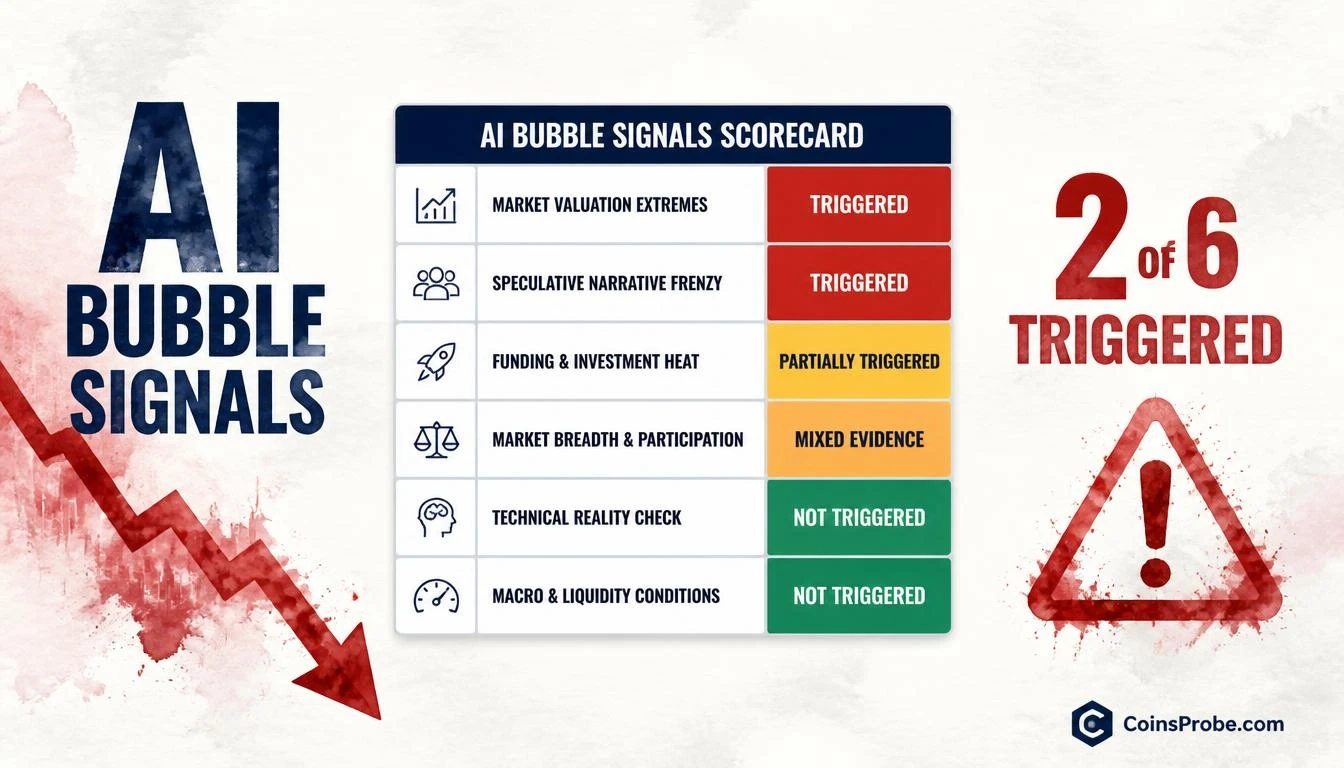

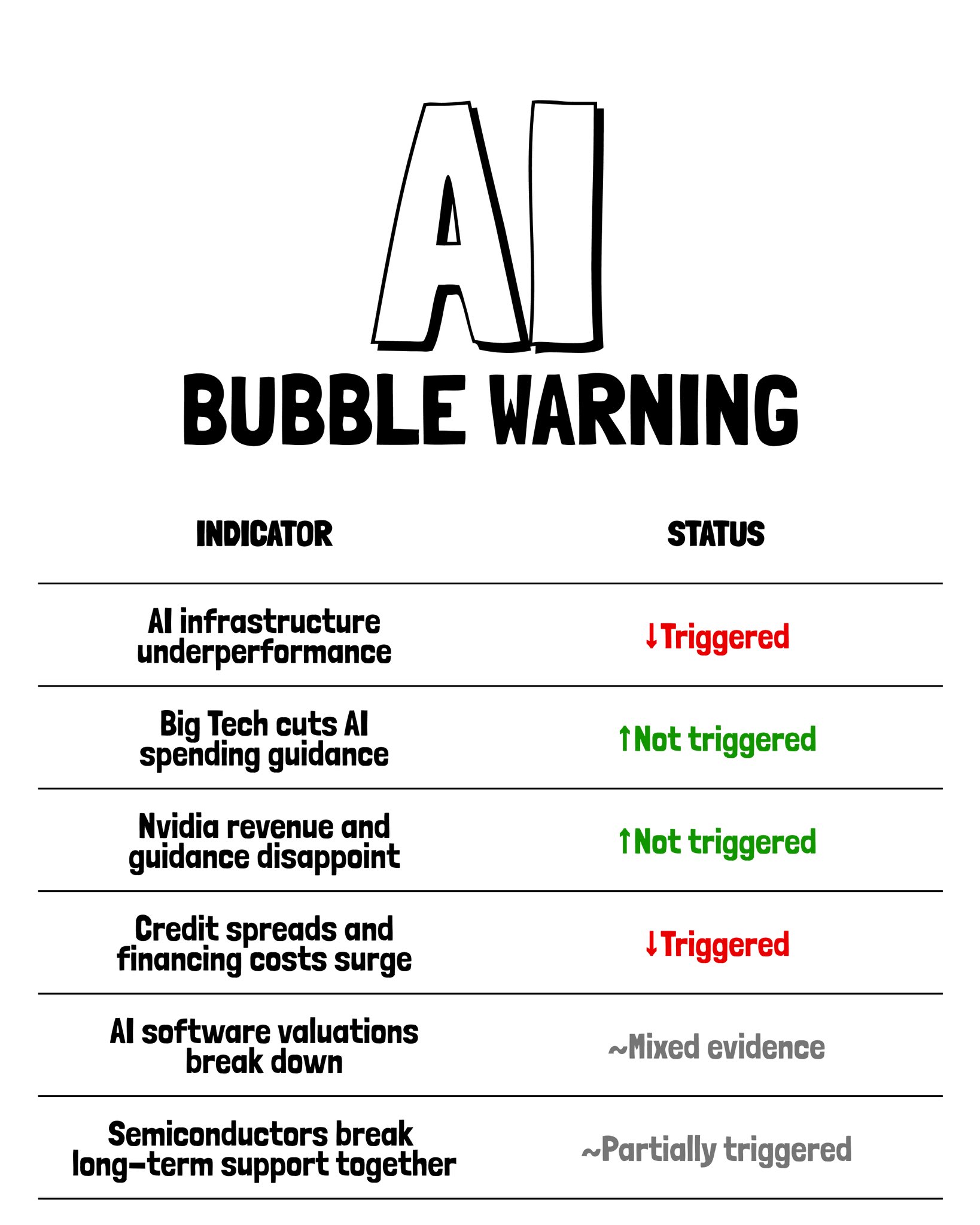
- 2 of 6 AI bubble signals are Triggered as of November 2026 — framework is partially active but not fully confirmed
- Signals cover 6 layers: infrastructure performance, capex guidance, earnings, credit markets, software valuations, chip technicals
- Software valuations and chip sector technicals remain the two Not Triggered signals — their activation would shift the composite to majority confirmed
- Framework design: waiting for all 6 to trigger simultaneously means confirmation arrives after the majority of losses have occurred
AI investment narratives have powered some of the most concentrated capital flows in modern market history. But a major cycle reversal, as one analyst argues, is never triggered by a single bad earnings print. It is triggered when multiple reinforcing pressure points activate simultaneously — financial stress, spending reductions, deteriorating earnings, and falling prices compounding into a regime shift.
That is the framework a crypto and macro analyst published on November 9, 2026, laying out six distinct signals designed to identify when the AI bubble is actively bursting — not in hindsight, but in real time. The core argument: cycle reversals are multi-factor events, and waiting for one clean signal means waiting too long.
Why Single-Signal Analysis Fails at Cycle Tops
Historically, major investment bubbles — dot-com, housing, clean energy — did not collapse on a single catalyst. They collapsed when stress in one part of the system began feeding stress in another. The analyst’s framework explicitly mirrors this structure: six signals across different layers of the AI investment stack, each capable of independent deterioration, but far more significant when several activate together.
The scorecard the analyst presents tracks six indicator categories. Two are currently flagged as Triggered. One shows Mixed evidence. One is Partially triggered. Two remain Not triggered. The composite reading: the bubble burst framework is partially active but not fully confirmed as of the November 2026 publication date.
The Six Signals — What Each Measures
Signal 1 — Infrastructure Performance (Triggered)
This tracks whether AI infrastructure investments are generating measurable returns relative to their capital cost. When hyperscalers pour hundreds of billions into compute buildout and revenue-per-unit metrics begin declining, the return-on-investment thesis that justified the capex cycle starts to crack. A “Triggered” reading here means that degradation is already observable in reported data — not projected.
Signal 2 — Corporate Spending Guidance (Triggered)
Capex guidance from the largest AI infrastructure buyers — cloud providers, semiconductor purchasers, enterprise AI adopters — is the leading indicator for the entire supply chain. When guidance revisions turn negative, or when companies begin qualifying forward spend with new conditions, the demand signal that sustained AI valuations starts reversing. This signal is marked Triggered, meaning at least one significant guidance revision is already on record.
Signal 3 — Deteriorating Earnings (Mixed Evidence)
Earnings deterioration across AI-exposed companies — not just one — signals whether the revenue model is following the infrastructure model downward. Mixed evidence here is structurally important: it means some companies are already reporting margin compression or revenue misses, while others have not yet shown the same pattern. Mixed readings at cycle tops are often the last stage before broad confirmation.
Signal 4 — Credit Markets (Partially Triggered)
Credit spread behavior around AI-heavy issuers is one of the most historically reliable early warning signals in any investment cycle. When spreads widen for companies in a thematic trade — even marginally — institutional capital is beginning to price risk differently than equity markets. A Partially Triggered reading suggests early stress in credit markets without full capitulation yet.
Signal 5 — Software Valuations (Not Triggered)
AI software multiples — price-to-revenue, EV/NTM — are the last layer to reprice in a bubble reversal. Infrastructure and hardware compress first; software multiples tend to hold longer on the narrative that “even if buildout slows, software monetization will follow.” A Not Triggered reading means software valuation compression has not yet begun in earnest, which is consistent with the framework being partially, not fully, active.
Signal 6 — Chip Sector Technicals (Not Triggered)
Semiconductor stock price action — specifically the SOX index and leading AI chip names — often provides the most visible confirmation of a cycle top. When chip stocks break key technical structures after multi-year advances, the market is pricing in demand destruction, not demand deceleration. This signal remains Not Triggered, meaning chip sector price action has not yet confirmed the breakdown implied by the fundamental signals above.
The Composite Reading — Why Partial Activation Matters
The scorecard as published shows 2 of 6 signals Triggered, 1 Partially Triggered, 1 Mixed, and 2 Not Triggered. That 50% partial activation rate is not a bullish clearance. It maps closely to how the dot-com reversal developed in 1999–2000: infrastructure spending peaked before software multiples peaked, which peaked before chip stocks confirmed the top. Signals activated in sequence, not simultaneously.
The analyst’s framework is explicitly designed for this sequence. Waiting for all six to trigger simultaneously is waiting for confirmation that arrives after the majority of losses have already occurred. The value of the scorecard is tracking the progression — from 2 Triggered toward 3, 4, and 5 — as the cycle deteriorates.
This connects directly to the broader question of AI compute as a financial asset class. As Grayscale and a16z have flagged, AI compute is increasingly being priced and traded as a derivatives market in its own right — meaning the bubble framework applies not just to equities but to compute pricing, tokenized infrastructure, and crypto assets with AI exposure.
What Needs to Trigger Next
The two Not Triggered signals — software valuations and chip sector technicals — are the ones that institutional capital is watching most closely. Software multiples compressing would signal that the narrative layer of AI monetization is breaking down, not just the infrastructure layer. Chip sector technical confirmation would provide the visual, price-action evidence that the equity market has re-rated the AI cycle.
When either of those two moves from Not Triggered to Triggered, the composite reading shifts from “partially active” to “majority confirmed.” At that point, the analyst’s framework would indicate the bubble burst is not a risk — it is a process already underway. For context on how crypto assets with AI exposure behave under this kind of macro pressure, see the on-chain signals currently explaining Bitcoin’s rebound failures.
What the Framework Says — and What It Doesn’t
What it says: Two of the six most historically reliable AI bubble indicators are already Triggered as of November 2026. The composite signal is partially active, consistent with the early-to-middle stages of a major cycle reversal.
What it doesn’t say: It does not set a price target for AI stocks, chips, or crypto. It does not specify a timeline. It does not claim the reversal is irreversible — a re-acceleration in corporate spending guidance, for example, could reset Signal 2 from Triggered back to Not Triggered.
What to watch for confirmation: Software valuation multiples (EV/NTM for leading AI software companies) moving into compression. SOX index breaking its major technical structure on a weekly close. If those two trigger, the scorecard reaches 4-of-6 — the threshold at which every prior comparable cycle had already entered confirmed reversal.
Traders positioned in AI-adjacent crypto assets — tokens with direct AI compute exposure, infrastructure plays, and high-beta tech-correlated positions — should be tracking all six signals, not just price action. As the analyst’s framing makes clear: by the time price confirms, the multi-factor deterioration will have been visible for weeks. Watch software valuations and chip sector technicals as the two remaining signals that determine whether this framework moves from partial to majority confirmation.
Frequently Asked Questions
What are the 6 signals used to identify when the AI bubble is bursting?
Does a partial trigger reading — 2 of 6 — mean the AI bubble has already burst?
Which two signals would most significantly change the outlook if triggered?
How does this AI bubble framework affect crypto assets with AI exposure?
Source: Ali Charts · Published by CoinsProbe Markets Desk
The opinions and market insights shared on CoinsProbe represent the views of individual authors based on prevailing market conditions at the time of publication. Cryptocurrency investments carry significant risk and volatility. Readers are encouraged to conduct their own research and seek professional financial advice before making investment decisions. CoinsProbe and its contributors do not accept responsibility for financial losses or decisions made based on published content.
CoinsProbe may publish sponsored articles, affiliate links, or promotional collaborations. All sponsored material is clearly labeled to maintain transparency with our audience. Our editorial decisions remain fully independent, and advertising partnerships do not influence reviews, rankings, or published opinions.
Since 2023, CoinsProbe has delivered reliable insights on cryptocurrency, blockchain, and digital assets. Our content is created by experienced researchers and analysts who follow strict editorial standards focused on accuracy, transparency, and credibility. Every article is carefully reviewed and verified using trusted sources and current market data. We provide unbiased analysis and timely updates covering everything from emerging crypto projects to major industry developments.