
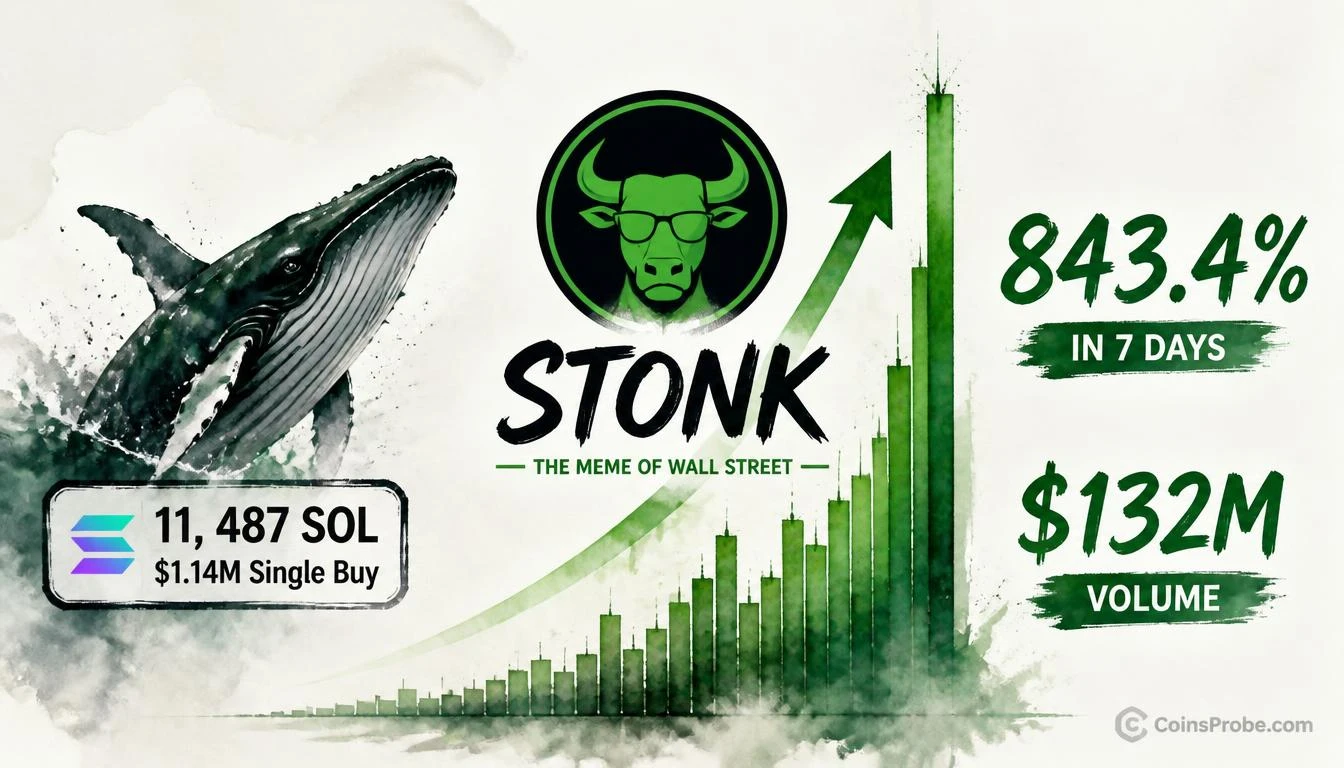
- STONK trades at $0.2963 — up 843.4% in 7 days — primary trigger: a single whale accumulation event
- One buyer spent 11,487 SOL (~$1.14M) to acquire 4.97M STONK tokens ~4 hours before the data update, per on-chain trackers
- 24-hour trading volume surged 57.53% to $132M following the whale buy, per CoinGecko
- Market cap reached ~$251.8M; Raydium LaunchLab integration and buy-and-burn tokenomics acted as secondary amplifiers
A single large-order whale purchase — not a partnership, not an exchange listing, not a protocol upgrade — is the primary documented trigger behind STONK’s extraordinary 7-day surge. The mechanism is straightforward: concentrated buying pressure from one identified actor ignited social momentum, which pulled in retail volume behind it.
At the time of writing, STONK is trading at approximately $0.2963, up 843.4% over the past seven days and 1.28% over the past 24 hours, with a 4.70% gain in the last hour. The token’s market capitalization stands at approximately $251.8 million, per CoinGecko data as of September 12, 2026.
The Primary Catalyst — A Single Whale Spent 11,487 SOL to Move the Market
Approximately four hours before the most recent data update, one large buyer deployed 11,487 SOL — roughly $1.14 million — into a single accumulation position, acquiring 4.97 million STONK tokens in the process. This single-order buy was identified by on-chain trackers as the immediate trigger of both the buying pressure and the social buzz that followed.
| Metric | Value |
|---|---|
| Whale SOL Spent | 11,487 SOL (~$1.14M) |
| STONK Acquired | 4.97 million tokens |
| 24H Trading Volume | $132M (+57.53%) |
| 7-Day Price Change | +843.4% |
| Current Market Cap | ~$251.8M |
Source: CoinGecko, on-chain data — September 12, 2026
Why a Single Whale Buy Moves a Low-Cap Token
In lower-liquidity environments, a concentrated market order absorbs available sell-side depth rapidly, pushing price sharply upward in a short window. That visible price action — particularly when the wallet size and SOL denomination are large enough to be flagged by on-chain alert services — generates immediate social amplification. Retail traders observing the move enter behind the whale, compounding the volume and extending the price action. The 57.53% jump in 24-hour trading volume to $132 million is the quantified result of that chain reaction.
Secondary Structural Factors — Raydium LaunchLab and Buy-and-Burn Tokenomics
Two structural elements provided the foundation that made STONK receptive to this kind of move. First, Raydium LaunchLab integration — reported to have meaningfully lowered token deployment costs on the platform — increased STONK’s accessibility and reduced friction for new participants. Second, STONK’s buy-and-burn tokenomics model creates a deflationary backdrop: trading volume directly reduces circulating supply, which mechanically tightens available float as volume climbs.
These factors were not the spark — the whale purchase was. But they explain why the spark found combustible conditions. A token without deflationary mechanics and platform accessibility would absorb the same whale buy with less price impact. These are secondary amplifiers to a primary order-flow catalyst. For context on how liquidation dynamics interact with sharp single-asset moves, see our earlier analysis: Why Is Ethereum (ETH) Up 3.11% Today? $303.98M in Liquidations Tell the Story.
Is STONK’s Rally Sustainable?
The honest answer requires separating what the data confirms from what it does not. What is confirmed: a whale-driven momentum event produced an 843.4% weekly return with $132 million in 24-hour volume. What is not confirmed: any structural change — new revenue stream, protocol partnership, or exchange listing — that would sustain elevated price independent of continued speculative demand. Whale-initiated moves in low-cap tokens frequently exhibit sharp mean reversion once the originating buyer begins distributing. The absence of a verified fundamental catalyst is the primary risk factor here.
The metric to monitor is daily trading volume on Raydium and total DEX activity for STONK. If volume sustains above $50 million per day without a new fundamental catalyst, that would indicate genuine retail continuation. A drop below that threshold on declining price action would signal the momentum phase is unwinding. On-chain wallet tracking via Solscan or Arkham remains the most reliable real-time signal for whether the originating whale is holding or distributing.
STONK’s 843.4% seven-day move traces directly to one documented event: an 11,487 SOL (~$1.14M) single-order whale accumulation that acquired 4.97 million tokens and triggered a 57.53% volume surge to $132 million in 24 hours. The Raydium LaunchLab integration and buy-and-burn tokenomics provided structural amplification, but neither constitutes an independent bullish catalyst. Watch daily DEX volume and on-chain wallet behavior from the originating address — those two data points will determine whether this becomes a sustained re-rating or a textbook liquidity event. Similar momentum-driven spikes in smaller assets have historically resolved on order-flow data, not narrative.
Source: coingecko.comFrequently Asked Questions
Why is STONK up 843.4% this week?
What is STONK’s current price and market cap?
What role did Raydium LaunchLab play in STONK’s surge?
Is STONK’s rally sustainable?
Source: CoinGecko Markets · Published by CoinsProbe Markets Desk
The opinions and market insights shared on CoinsProbe represent the views of individual authors based on prevailing market conditions at the time of publication. Cryptocurrency investments carry significant risk and volatility. Readers are encouraged to conduct their own research and seek professional financial advice before making investment decisions. CoinsProbe and its contributors do not accept responsibility for financial losses or decisions made based on published content.
CoinsProbe may publish sponsored articles, affiliate links, or promotional collaborations. All sponsored material is clearly labeled to maintain transparency with our audience. Our editorial decisions remain fully independent, and advertising partnerships do not influence reviews, rankings, or published opinions.
Since 2023, CoinsProbe has delivered reliable insights on cryptocurrency, blockchain, and digital assets. Our content is created by experienced researchers and analysts who follow strict editorial standards focused on accuracy, transparency, and credibility. Every article is carefully reviewed and verified using trusted sources and current market data. We provide unbiased analysis and timely updates covering everything from emerging crypto projects to major industry developments.