

- UNI trading at ~$7.38, up 37.58% over 30 days, identified by CryptoBullet1 as a wave (2) pullback base
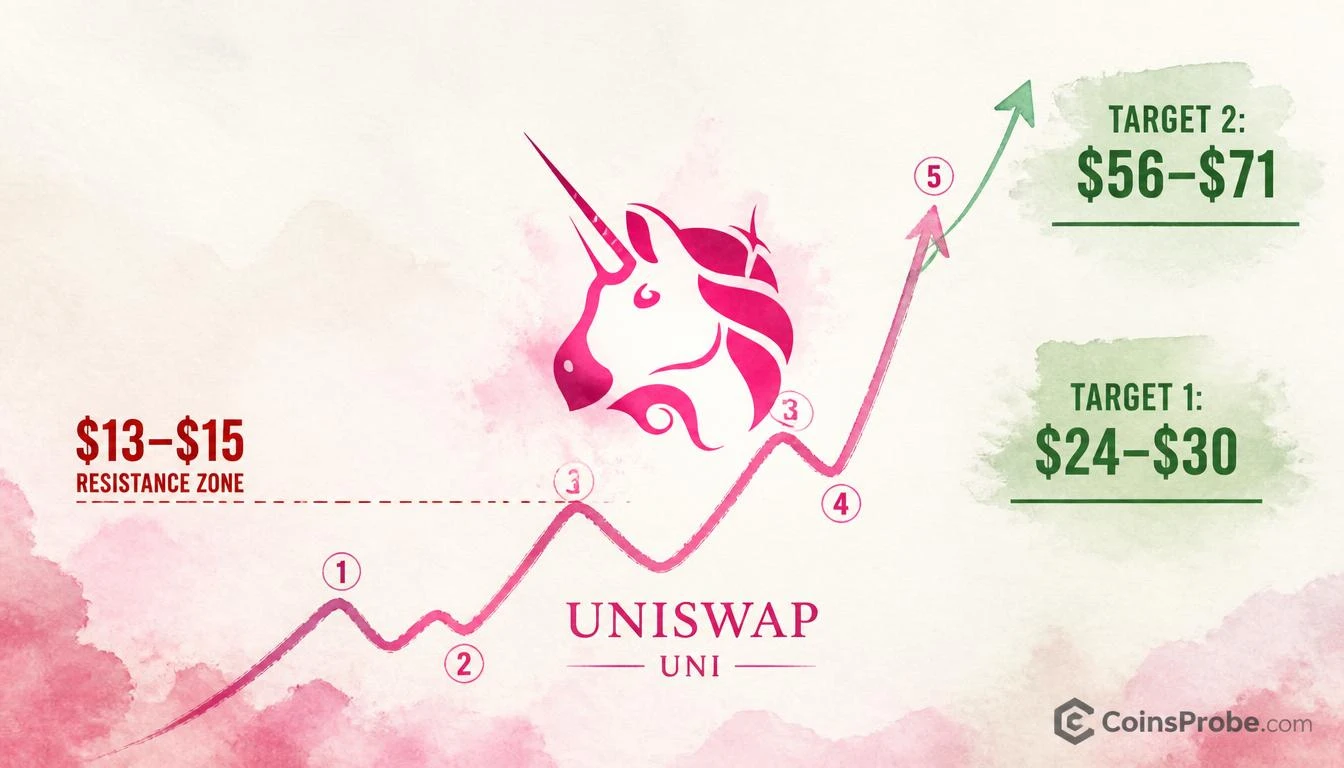
- Major Resistance at $13–$15 — monthly close above $15 required to activate macro targets
- Macro Target 1: $24–$30 (0.786 Fib, ~3.2x–4.1x from current); Macro Target 2: $56–$71 (1.618 Fib, ~7.6x–9.6x)
- Uniswap processes $1–$2B daily volume; UNI supply burns mechanically tied to protocol usage
Uniswap’s governance token is trading at approximately $7.38 — down 16.90% on the monthly candle per the chart’s OHLC bar — yet analyst CryptoBullet1 (@CryptoBullet1) is publishing one of the most structurally specific macro calls on UNI seen this cycle. The thesis is not a near-term trade setup. It is a multi-year Elliott Wave projection anchored in one non-negotiable fundamental: Uniswap is the largest decentralized exchange on-chain, and its token supply is mechanically tied to protocol usage through burns.
CryptoBullet1 identifies the current price action as a wave (2) pullback bottom — the corrective phase in a five-wave Elliott Wave impulse structure — on the monthly candle chart. The projection maps five sequential waves off the current base, with each target zone derived from Fibonacci extension levels printed directly on the chart. Two macro targets are stated explicitly: Macro Target 1 at $24–$30 (near the 0.786 Fibonacci zone) and Macro Target 2 at $56–$71 (near the 1.618 extension). Standing between UNI and those targets is a single clearly-labeled resistance band: $13–$15.
The Fundamental Anchor — Burn Mechanics Tie UNI Supply to Protocol Revenue
Before addressing the chart levels, the mechanism matters. CryptoBullet1 explicitly flags Uniswap’s supply burn as the fundamental support for a macro bullish thesis. Uniswap processes $1–$2 billion in daily trading volume, making it the dominant DEX by volume. Each incremental unit of protocol usage reduces UNI’s circulating supply. This is not a speculative correlation — it is a direct mechanical link between protocol activity and token scarcity. Unlike governance tokens that derive value purely from voting rights, UNI has a structural deflationary pressure tied to one of crypto’s most durable on-chain businesses. As broader DeFi activity scales — and derivatives open interest has grown 570% since 2021, reflecting the depth of crypto market infrastructure — Uniswap’s position as the primary spot DEX becomes increasingly load-bearing.
The Elliott Wave Structure — Wave (2) Bottom and a Five-Wave Projection
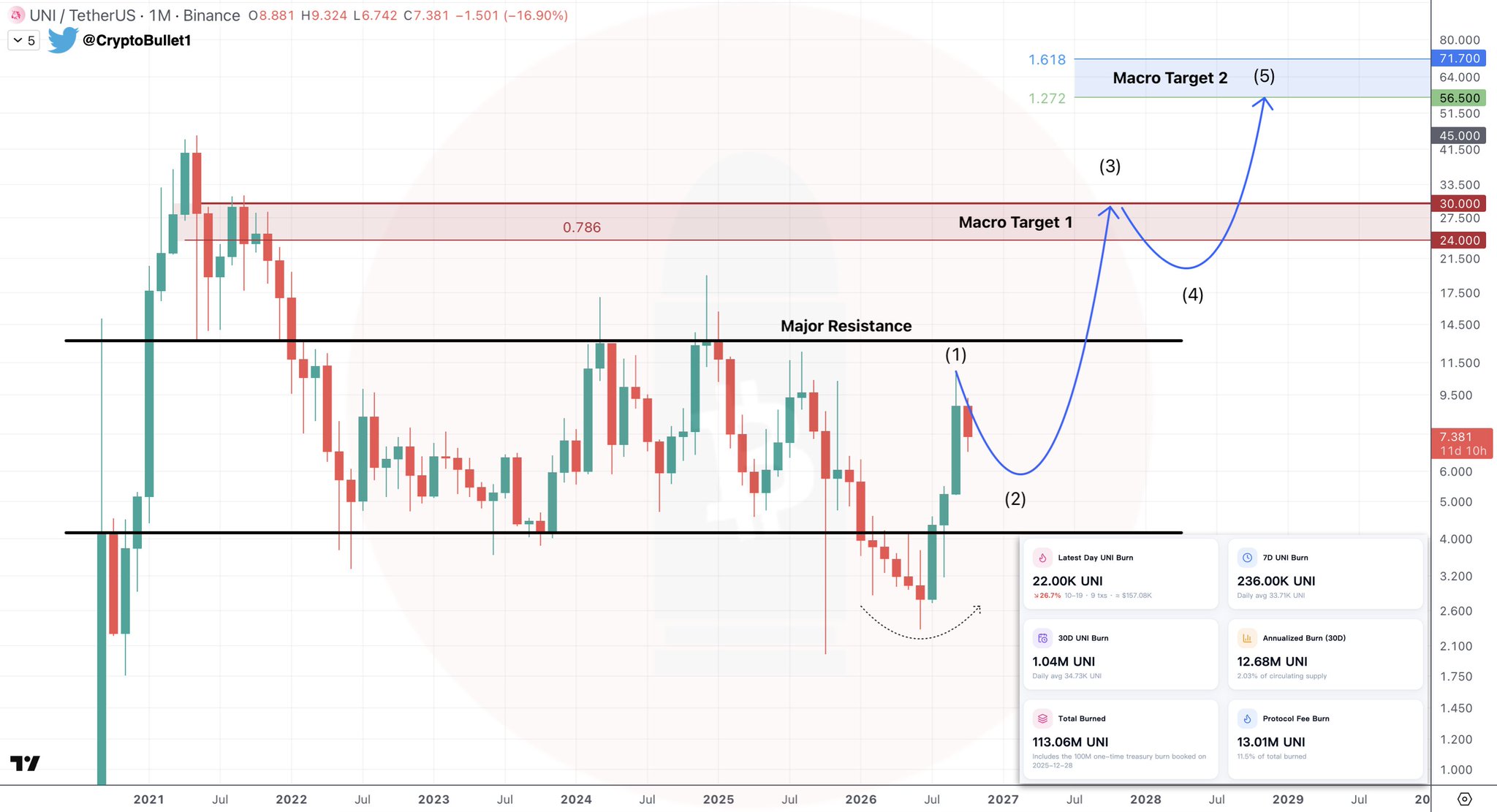
The monthly chart shared by CryptoBullet1 displays a classic five-wave Elliott Wave impulse labeled (1) through (5). The analyst places UNI currently at the base of wave (2) — the corrective pullback that precedes what Elliott theory defines as the strongest and longest leg of the structure, wave (3). The chart’s OHLC data for the current monthly candle reads: Open $8.881, High $9.324, Low $6.742, Close $7.381. The wave structure is drawn as a curved blue arrow sequence ascending through successive peaks, projecting a multi-year rally from current levels through two discrete Fibonacci-derived targets.
The Fibonacci levels printed on the chart are 0.786, 1.272, and 1.618. The analyst maps Macro Target 1 ($24–$30) to the 0.786 zone and Macro Target 2 ($56–$71) to the 1.618 extension. These are not arbitrary numbers — they are derived from the measured move of the prior wave structure extended forward. The $24–$30 zone represents approximately a 3.2x–4.1x move from current levels. The $56–$71 zone represents a 7.6x–9.6x move from the current $7.38 print.
The Critical Level — $13–$15 Major Resistance
CryptoBullet1 does not bury the critical threshold. The post labels it plainly: Major Resistance at $13–$15. This band corresponds to a prior structural high zone on the monthly chart and sits between the current price and Macro Target 1. The wave (3) projection cannot be validated without a confirmed breakout above this zone. Until UNI produces a monthly close above $15, the Elliott Wave count remains a projection — not a confirmed impulse. A monthly close above $15 would clear the only labeled resistance on CryptoBullet1’s map and open the path toward $24–$30 in wave (3) and $56–$71 in wave (5).
| Level / Zone | Price Range | Significance |
|---|---|---|
| Current Price | ~$7.38 | Wave (2) pullback base per CryptoBullet1 |
| Major Resistance | $13–$15 | Must break for macro thesis to activate |
| Macro Target 1 | $24–$30 | 0.786 Fibonacci extension (~3.2x–4.1x) |
| Macro Target 2 | $56–$71 | 1.618 Fibonacci extension (~7.6x–9.6x) |
Source: @CryptoBullet1 (X), October 20 2026
30-Day Performance Context
Despite the current monthly candle’s drawdown shown on the chart, UNI has gained 37.58% over the past 30 days. The current monthly candle is open and does not represent a completed close — the chart’s -16.90% reflects price action from the candle’s open at $8.881, not a finalized monthly return. The 30-day gain reflects the rally that preceded this candle’s pullback, and CryptoBullet1’s wave (2) thesis is consistent with exactly this type of corrective retracement following an initial advance.
Bullish Scenario — Monthly Close Above $15
A confirmed monthly close above $15 clears the sole labeled resistance on CryptoBullet1’s macro map. This activates the wave (3) projection toward Macro Target 1 ($24–$30). From $24–$30, the wave (4) correction would precede a final wave (5) advance into Macro Target 2 ($56–$71). The burn mechanics accelerate this path if Uniswap’s $1–$2 billion daily volume continues or expands, reducing circulating supply into each successive rally leg.
Bearish Scenario — Failure to Reclaim $13
If UNI fails to reclaim the $13 level on a monthly closing basis, the wave (2) bottom is not confirmed and the Elliott count is not validated. Monthly closes below the current $6.742 candle low would invalidate the wave (2) base reading and shift the structure into a deeper corrective phase — putting the macro thesis on hold without a clear timeline for reactivation.
The macro setup CryptoBullet1 presents is structurally clean: the largest DEX by volume, a burn mechanism tying token supply to protocol usage, and a monthly chart projecting five waves from what the analyst identifies as a wave (2) base. The entire structure activates or fails at one address — $13–$15. A monthly close above $15 opens $24–$30. A monthly close above $30 opens $56–$71. The DeFi volume data from Uniswap’s protocol will answer in real time whether the fundamental engine behind the thesis is running at sufficient capacity. Watch $13 as the first confirmation level the market must deliver.
Frequently Asked Questions
What is the $13–$15 resistance on UNI and why does it matter?
How does Uniswap’s burn mechanism support the UNI price thesis?
What Fibonacci levels are used for UNI’s macro targets of $24–$30 and $56–$71?
Where does the UNI Elliott Wave count get invalidated?
Source: Cryptobullet1 · Published by CoinsProbe Markets Desk
The opinions and market insights shared on CoinsProbe represent the views of individual authors based on prevailing market conditions at the time of publication. Cryptocurrency investments carry significant risk and volatility. Readers are encouraged to conduct their own research and seek professional financial advice before making investment decisions. CoinsProbe and its contributors do not accept responsibility for financial losses or decisions made based on published content.
CoinsProbe may publish sponsored articles, affiliate links, or promotional collaborations. All sponsored material is clearly labeled to maintain transparency with our audience. Our editorial decisions remain fully independent, and advertising partnerships do not influence reviews, rankings, or published opinions.
Since 2023, CoinsProbe has delivered reliable insights on cryptocurrency, blockchain, and digital assets. Our content is created by experienced researchers and analysts who follow strict editorial standards focused on accuracy, transparency, and credibility. Every article is carefully reviewed and verified using trusted sources and current market data. We provide unbiased analysis and timely updates covering everything from emerging crypto projects to major industry developments.