

Layer-1 smart contract platforms have entered a new growth phase, with Sui quietly establishing itself as a contender in the scalability race. Built on the Move programming language, Sui introduces parallel transaction execution, which enables faster processing and reduced congestion. As of mid-2025, SUI maintains a strong position in the top 50 cryptocurrencies by market cap, with over $9.5 billion in value and increasing adoption among DeFi developers.
The unique consensus mechanism and a developer-centric ecosystem have allowed Sui to differentiate from Ethereum and Solana. According to Messari, Sui’s growth trajectory is driven by high-speed throughput and an innovative object-centric data model that enhances programmability. With more applications integrating the network, analysts are forecasting SUI could surpass its current levels in 2026, particularly as real-world adoption of Layer-1 solutions increases.
SUI’s Parallel Execution Model: Technical Edge for 2026
Unlike traditional blockchains that process transactions sequentially, Sui leverages a parallel execution engine. This feature reduces latency and increases throughput, ideal for use cases involving high-volume microtransactions, NFTs, and games. It is this core architecture that places Sui at the forefront of technical innovation among emerging blockchains.
Recent developer activity tracked by Electric Capital shows Sui has seen a 28% rise in GitHub contributions over the past 90 days. These metrics suggest expanding developer confidence. Sui’s ecosystem now hosts over 140 decentralized applications and has processed hundreds of millions of transactions.

With the anticipated rollout of deeper zero-knowledge integrations and new gas fee optimization tools in Q4 2025, the platform may further strengthen its position heading into 2026.
SUI Price Prediction 2026: Data-Backed Forecasts
Price models built around usage growth and circulating supply suggest a mid-range SUI valuation between $2.90 and $4.45 by 2026. According to CoinCodex, bullish projections extend as high as $7.68 if transaction activity, staking participation, and dApp deployments increase. On the conservative end, forecasts from Changelly point to an average of $1.92.
Key variables influencing SUI’s price prediction for 2026 include the total value locked (TVL) in DeFi protocols, staking yields, and adoption across enterprise-grade applications. As of June 2025, Sui has seen over 23% quarter-on-quarter growth in network activity.
Technical indicators support a bullish narrative. The 50-day and 200-day moving averages are converging, suggesting a breakout pattern. With volume steadily increasing and the RSI hovering in the 55–60 range, the outlook remains favorable barring macroeconomic downturns.
Institutional Demand and Interoperability Are Fueling SUI’s Long-Term Growth
One of the defining advantages of Sui is its emerging interoperability infrastructure. The network’s planned integration with external Layer-1 chains via cross-chain bridges, including Ethereum and Cosmos, could expand liquidity and application deployment.
In recent quarters, institutional wallets have grown their SUI holdings. According to WhaleStats, there has been a 16% uptick in wallets holding over 1 million tokens since Q1 2025. Such accumulation signals strong market confidence. If institutional adoption continues, it could accelerate SUI’s market cap expansion and drive pricing toward high-range estimates.
Sui’s roadmap also includes the introduction of zkLogin, which allows users to authenticate using familiar Web2 credentials. This feature has attracted attention from enterprise developers seeking a more seamless user onboarding experience.
Qubetics Breaks Out with $4.20 High on Listing Day
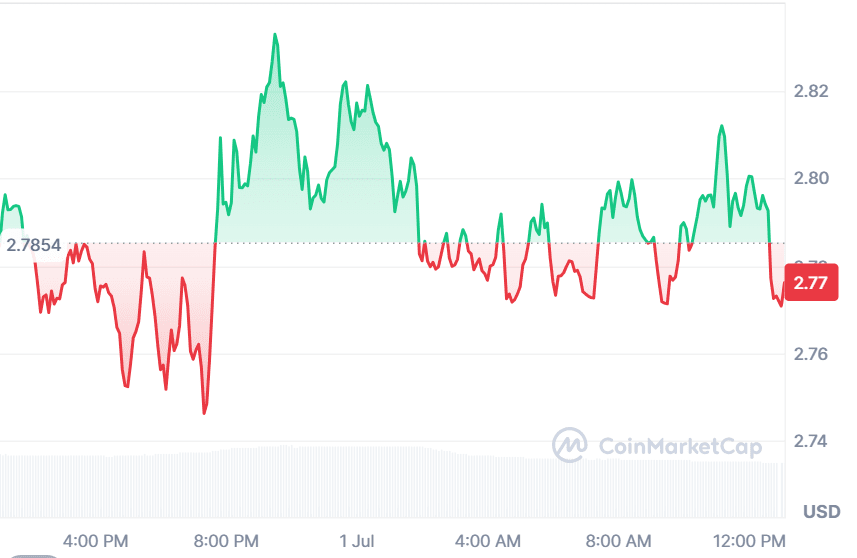
While Sui’s 2026 outlook draws attention, Qubetics has delivered an immediate impact that’s hard to ignore. On June 30th, Qubetics ($TICS) launched on MEXC and LBank at an initial exchange price of $0.40. Within just one hour, it reached an all-time high of $4.20, representing a stunning 950% surge in a single trading session.
This listing also included support on SWFT Bridge, reinforcing its multichain operability. According to early exchange data, trade volume on MEXC exceeded $700,000 within the first 24 hours, positioning Qubetics as one of the most dynamic Layer-1 entrants of 2025. Buyers have shown considerable interest near the $2 support level, where high buying pressure has consistently been observed, indicating a strong floor forming early in its market phase.
QubeQode and Qubetics IDE: Fueling Developer Onboarding
What sets Qubetics apart isn’t just price performance but its commitment to practical tools for ecosystem growth. QubeQode, its flagship low-code development platform, allows developers and teams to deploy smart contracts and dApps without advanced coding skills. This utility makes blockchain entry more accessible for startups and enterprises.
Complementing this is the Qubetics IDE (Integrated Development Environment), a full-stack toolkit designed to streamline smart contract creation, testing, and deployment. The IDE is compatible with multiple virtual machines, allowing cross-chain functionality and enabling developers to build scalable, production-ready apps with minimal friction.
These applications are already driving a wave of deployments across decentralized finance, logistics, and real-world asset tokenization. The strategy is simple but effective: remove friction for developers and accelerate adoption through simplified tools.
Qubetics Launch Performance and Market Trajectory
Qubetics’ rise was engineered through a meticulous 37-stage presale. The token price began at $0.01 and gradually increased to $0.3370 by the final stage, reflecting a structured and transparent distribution model. This approach rewarded early adopters while ensuring steady capital inflow throughout the presale lifecycle.
By the time it listed at $0.40, early-stage participants had already realized gains of over 3,900%. The surge to $4.20 in the first hour pushed the ROI for Stage 1 participants to an extraordinary 41x. Analysts are forecasting a medium-term trading range between $5 and $10 as utility expands and listings on additional centralized exchanges are expected.
The listing event is more than just a liquidity trigger. It marks the beginning of Qubetics’ broader expansion roadmap. Key catalysts include onboarding retail participants, attracting institutional market makers, and expanding developer adoption. These developments are expected to strengthen token velocity, improve market efficiency, and deepen ecosystem engagement in Q3 and Q4 of 2025.
Final Thoughts:
Sui and Qubetics represent distinct but complementary trajectories within the Layer-1 blockchain space. Sui offers a technically refined platform with proven scalability, backed by growing institutional confidence and developer engagement. With strong indicators pointing toward a potential breakout, SUI price prediction for 2026 remains on the bullish side of neutral, supported by real-world traction and infrastructure expansion.
Meanwhile, Qubetics has entered the scene with aggressive momentum, achieving a post-launch high of $4.20 and establishing itself as a high-velocity asset. Its utility-driven ecosystem, developer-focused tooling, and successful multistage presale model make it one of the best altcoin to buy now moving into the second half of 2025.
Both projects reflect the maturing Layer-1 narrative: speed, accessibility, and cross-chain capability. Their shared focus on user experience, developer tools, and ecosystem growth indicates a stronger, more functional blockchain future, one that rewards utility over hype.

For More Information:
Qubetics: https://qubetics.com
Telegram: https://t.me/qubetics
Twitter: https://x.com/qubetics
Disclaimer: This article is a sponsored press release for informational purposes only. Coinsprobe does not endorse or guarantee the accuracy, quality, or reliability of any content, products, or services mentioned. The views expressed do not reflect those of Coinsprobe and are not financial, legal, or investment advice. Investing in crypto assets carries significant risk. Readers should conduct their own research and act at their own risk. Coinsprobe is not liable for any losses or damages arising from reliance on this content.

The opinions and market insights shared on CoinsProbe represent the views of individual authors based on prevailing market conditions at the time of publication. Cryptocurrency investments carry significant risk and volatility. Readers are encouraged to conduct their own research and seek professional financial advice before making investment decisions. CoinsProbe and its contributors do not accept responsibility for financial losses or decisions made based on published content.
CoinsProbe may publish sponsored articles, affiliate links, or promotional collaborations. All sponsored material is clearly labeled to maintain transparency with our audience. Our editorial decisions remain fully independent, and advertising partnerships do not influence reviews, rankings, or published opinions.
Since 2023, CoinsProbe has delivered reliable insights on cryptocurrency, blockchain, and digital assets. Our content is created by experienced researchers and analysts who follow strict editorial standards focused on accuracy, transparency, and credibility. Every article is carefully reviewed and verified using trusted sources and current market data. We provide unbiased analysis and timely updates covering everything from emerging crypto projects to major industry developments.