

Is Polygon’s shift toward POL enough to revive its long-term momentum, or are structural weaknesses still pulling at its base? The coin’s transition from MATIC to POL reflects a strategic evolution in token utility and governance, yet price activity in 2025 shows mixed signals. With a weak long-term moving average trend and limited bullish divergence, traders are left questioning whether Polygon can reclaim its role as a frontrunner or if the token’s underperformance will stretch into 2030.
While Polygon works through technical pressure, Qubetics has already captured early attention by hitting an all-time high of $4.20 within its first hour of launch and securing a top 10 spot on CoinMarketCap. The project combines functional infrastructure with interoperability across chains and Delegated Proof of Stake (DPoS) rewards, making it one of the most talked-about protocols of 2025. Polygon price prediction 2030 expectations project a value of around $0.23 by the decade’s close, according to technical forecasts. This puts a spotlight on accumulation ranges and use-case strength, rather than short-term volatility. Market watchers focused on long-term growth remain attentive to these foundational shifts.
Technical Forecast Aligns with Cautious Optimism
Technical indicators for POL reflect cautious optimism, with some signs of short-term resilience. The 50-day moving average on the 4-hour chart shows a slight uptrend, confirming bullish activity in tighter timeframes. However, the broader 200-day moving average continues to slope downward, maintaining pressure on the asset’s recovery efforts since early July 2025. These conflicting indicators create a measured but non-aggressive trading environment for POL.

Momentum metrics, including the Relative Strength Index (RSI), hold in a neutral zone between 30 and 70, suggesting that while there is no overbought signal, neither is there strength for a breakout. Analysts note that absence of bearish or bullish divergence across the past two weeks further supports a holding pattern. This kind of technical setup is typical for coins at transition points, especially those that are rebranding or adjusting tokenomics.
Short-Term Gains Do Not Reflect Broader Confidence
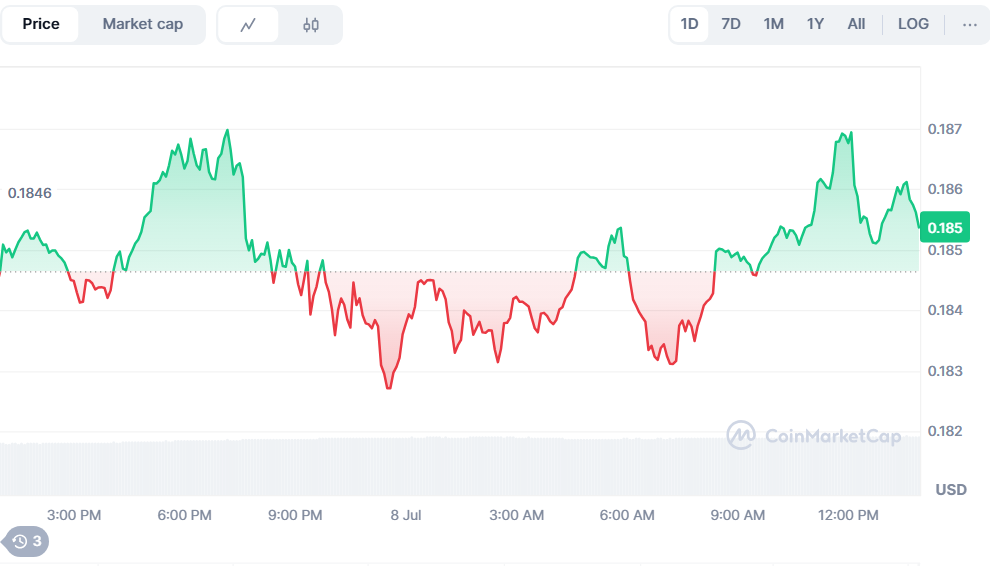
On a weekly projection basis, POL is forecast to rise by around 5% from its current range, possibly reaching $0.1841 by the end of the week. This minor uptick is not seen as a trend reversal but rather a reaction to temporary trading patterns. These micro-level changes do not yet suggest renewed interest at scale, which could be due to the market still adjusting to the new POL token framework following MATIC’s phasing out.
The lack of sufficient consensus data further signals caution among community members, who may still be re-evaluating POL’s place in a fast-moving Layer 2 and Ethereum-scaling market. Despite being among the earlier success stories in the rollup ecosystem, POL must now re-establish its value proposition with more than just branding changes. Sustained price recovery will depend heavily on Polygon’s ability to restore confidence among developers and long-term participants.
Polygon Price Prediction 2030 Remains Modest Amid Broader Shifts
The current projection estimates POL to reach approximately $0.234744 by 2030, reflecting a modest 5% annual growth rate over the next five years. For traders focused on long-term accumulation, this projection suggests conservative gains in a market increasingly dominated by high-yield protocols and cross-chain liquidity providers. While this growth may appear slow, it also suggests that POL could stabilize in a new role as a transactional utility asset, rather than a growth-focused coin.
This Polygon price prediction 2030 outlook is grounded in the current chart trends and forecast data, not speculative narratives. Those who expect exponential growth from this token may find the technicals lacking conviction. However, steady network improvements and consistent Layer 2 infrastructure could still attract meaningful volumes in the coming years if rebranding is followed by ecosystem expansion.

Qubetics Launches Decentralized VPN to Reinforce On-Chain Privacy
Qubetics has formally launched its decentralized VPN (dVPN), designed to offer encrypted internet access across a fully peer-to-peer network. This privacy-focused utility operates without any central authority, eliminating traditional vulnerabilities seen in legacy VPN systems. No user data can be logged, censored, or stored, ensuring that both identity and traffic remain secure. Blockchain-based design ensures transparency while minimizing entry barriers and points of failure.
In real-world terms, Qubetics’ dVPN provides a model similar to how decentralized storage networks like Filecoin distribute responsibility. Instead of storing files, however, users share bandwidth and maintain access to private, censorship-resistant web browsing. Users who contribute bandwidth are rewarded with $TICS tokens, creating an organic incentive system. This application combines security, scalability, and accessibility for participants seeking full control of their digital presence, further enriching the Qubetics ecosystem. The protocol has now become part of the broader conversation surrounding Polygon price prediction 2030 due to its unique utility-driven infrastructure.
Qubetics Price Momentum Grows Following ATH, Trade Volume Spike
Qubetics has already made a strong impact since its public launch, reaching an all-time high of $4.20 within the first hour of listing. This immediate gain came after raising more than $18.4 million in its presale, with over 28,500 participants acquiring more than 517 million $TICS tokens at early-stage prices. From a presale value of $0.01, Qubetics registered a 420x increase to its peak level, marking one of the most dramatic early returns in recent memory.
Early market participants who purchased $1,000 worth of $TICS at $0.01 each would now be sitting on a portfolio worth $420,000 at peak pricing. Even with current consolidation around a strong support level of $2, the project has demonstrated significant staying power. Trading volume crossed $700,000 in the first 24 hours on MEXC, reflecting strong demand despite broader market uncertainty.
Beyond price action, the Qubetics validator and delegator framework offers up to 30% APY for those securing the network. To become a validator, one must hold a minimum of 25,000 $TICS, while delegators need at least 5,000 tokens to begin earning a share of those rewards. This Delegated Proof of Stake (DPoS) model promotes both security and governance while enabling token holders to passively benefit from network growth. Qubetics’ cross-chain compatibility eliminates the need for bridges or third-party KYC platforms when moving assets between chains like Bitcoin and Ethereum, making it a practical alternative for users seeking efficiency and privacy.
Analysts now suggest Qubetics could rise to $10 to $15 after its full mainnet deployment. Given its early price activity, strong user incentives, and top 10 CoinMarketCap ranking, this projection is increasingly considered achievable. Community members who missed out on this opportunity now view it as one of the best crypto ICO to invest in retrospect, especially as it provided rare early-stage gains even larger than those once seen during Ethereum’s initial launch period.
Conclusion: Polygon Price Prediction 2030 and the Emerging Role of Functional Protocols
The Polygon price prediction 2030 forecast indicates steady but modest appreciation, with technical models suggesting the asset could trade near $0.23 by the end of the decade. While its rebranding to POL may reinvigorate interest, the coin’s mid-2025 technicals do not yet support aggressive upward projections. It remains a notable platform in the Ethereum-scaling space, yet it must continue building developer trust and use-case traction to reclaim its earlier momentum.
On the other hand, Qubetics has delivered exceptional returns in its initial phase, showing strong trade volume, validator rewards, and real-world application through its decentralized VPN. From a functional standpoint, the ability to offer privacy-centric utilities and non-custodial income via Delegated Proof of Stake separates Qubetics from typical token projects. While Polygon may still play a foundational role in long-term infrastructure, projects like Qubetics illustrate the rising demand for utility-backed assets, especially among those who missed what was widely viewed as the best crypto ICO to invest in this cycle.
Participants tracking both coins should remain attentive to their respective developments. POL may see slower gains through stability and gradual technical improvement. Qubetics, meanwhile, continues to attract attention with interoperable features and real-world applications, making its post-mainnet trajectory a closely monitored event.

For More Information:
Qubetics: https://qubetics.com
Telegram: https://t.me/qubetics
Twitter: https://x.com/qubetics
Summary
Polygon’s recent performance suggests moderate recovery potential, with forecasts placing it at $0.234744 by 2030 based on conservative models. The token shows near-term gains and neutral RSI levels but lacks decisive signals for rapid growth. In contrast, Qubetics launched with significant early strength, reaching $4.20 from an initial $0.01 presale price, marking a 420x gain. It raised $18.4 million from over 28,500 early participants and now offers 30% APY through its validator-delegator DPoS model. Its decentralized VPN and cross-chain functions support its place in the top 10 CMC rankings, with analysts predicting future price levels of $10 to $15. While Polygon remains a steady protocol, Qubetics stands out for combining functional application with strong price action, offering one of the clearest examples of a missed opportunity among the best crypto ICO to invest.
Disclaimer: This article is a sponsored press release for informational purposes only. Coinsprobe does not endorse or guarantee the accuracy, quality, or reliability of any content, products, or services mentioned. The views expressed do not reflect those of Coinsprobe and are not financial, legal, or investment advice. Investing in crypto assets carries significant risk. Readers should conduct their own research and act at their own risk. Coinsprobe is not liable for any losses or damages arising from reliance on this content.

The opinions and market insights shared on CoinsProbe represent the views of individual authors based on prevailing market conditions at the time of publication. Cryptocurrency investments carry significant risk and volatility. Readers are encouraged to conduct their own research and seek professional financial advice before making investment decisions. CoinsProbe and its contributors do not accept responsibility for financial losses or decisions made based on published content.
CoinsProbe may publish sponsored articles, affiliate links, or promotional collaborations. All sponsored material is clearly labeled to maintain transparency with our audience. Our editorial decisions remain fully independent, and advertising partnerships do not influence reviews, rankings, or published opinions.
Since 2023, CoinsProbe has delivered reliable insights on cryptocurrency, blockchain, and digital assets. Our content is created by experienced researchers and analysts who follow strict editorial standards focused on accuracy, transparency, and credibility. Every article is carefully reviewed and verified using trusted sources and current market data. We provide unbiased analysis and timely updates covering everything from emerging crypto projects to major industry developments.