
Litecoin continues to prove its resilience as one of the most consistent players in the cryptocurrency space. With nearly 12 years of uninterrupted uptime, a robust security model, and growing Layer-2 integrations, many analysts are re-evaluating Litecoin’s long-term trajectory. Forecasts now suggest a potential climb toward $800 by 2030. Meanwhile, Qubetics has made headlines after reaching an all-time high of $4.20 just one hour after listing. It is now trending in CoinMarketCap’s Top 10, drawing attention to the shifting competitive landscape.
Litecoin’s Longevity and Network Stability Fuel Optimism
Litecoin operates as a peer-to-peer payment system built on a Proof-of-Work consensus mechanism. It shares much of Bitcoin’s original source code but boasts a faster block generation time of 2.5 minutes and a lower transaction fee structure. These features have contributed to its sustained use in everyday transactions, particularly in e-commerce and remittance corridors.
One of Litecoin’s most notable strengths lies in its upgrade adoption rate. The network was the first to implement Segregated Witness (SegWit), which improves scalability and transaction efficiency. It also adopted the Lightning Network early, enabling near-instant payments with negligible fees. Most recently, the Mimblewimble Extension Block (MWEB) upgrade introduced optional privacy features without disrupting Litecoin’s base layer. This layered approach allows for transactional flexibility, addressing diverse user needs.

Can Technical Progress Justify a Price Tag of $800 by 2030?
Several forecast models predict a wide range of possibilities for Litecoin over the next five years. Changelly estimates a 2030 high of $866, while CoinCodex projects a more conservative $213.94. Factors that could support an $800 target include increased adoption in developing economies, integrations with payment processors, and the launch of new financial products.
Recently, Coinbase introduced cbLTC, a wrapped version of Litecoin on the Base Layer-2 network. This development allows LTC to enter decentralized finance ecosystems, expanding its utility beyond simple transactions. In parallel, the launch of LitVM, a zero-knowledge Layer-2 platform for smart contracts, has pushed Litecoin deeper into programmable finance. These additions bring new use cases like lending, yield farming, and decentralized exchanges to a previously non-programmable asset.
Another important catalyst could be the anticipated Litecoin ETF. Bloomberg analysts estimate a 95% chance of a U.S. spot Litecoin ETF approval by October 2025. Approval would open the door to institutional participation and introduce significant demand pressure.
Litecoin also benefits from a well-structured monetary policy. With a max supply of 84 million coins and halving events every four years, it provides long-term scarcity. The next halving in July 2027 will reduce the block reward from 6.25 LTC to 3.125 LTC, tightening supply further and potentially lifting prices.
Realistic Price Modeling and Investor Outlook
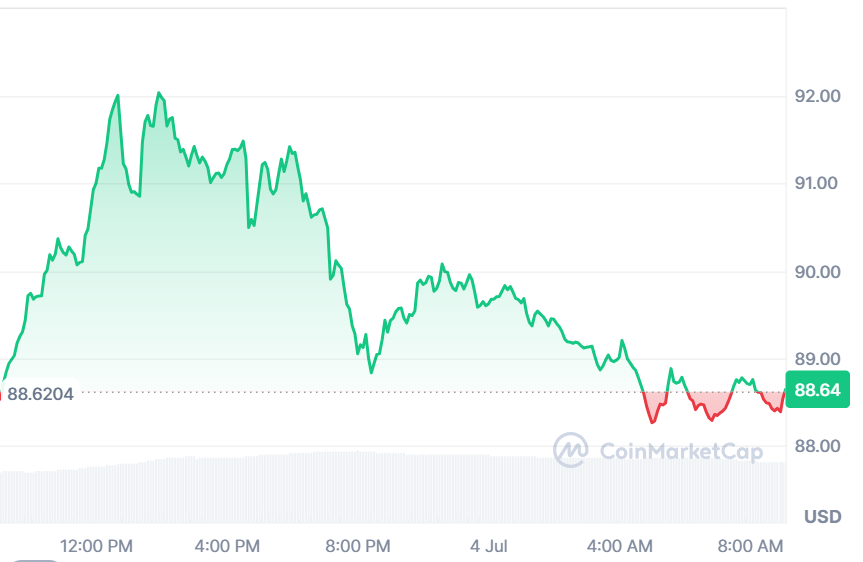
At the time of writing, Litecoin trades near $88 with a market capitalization of roughly $6.7 billion. If it were to reach $800, it would imply a market cap of over $60 billion. Achieving this would require steady user growth, broader institutional demand, and favorable macroeconomic conditions.
If LTC follows a compounded annual growth rate of just over 32%, $800 becomes a feasible long-term target. This figure aligns with prior growth cycles and mirrors performance seen during Bitcoin’s halving cycles. However, the ecosystem must sustain development and fend off competition from newer blockchains that offer faster and more flexible protocols.
External Risks That Could Cap Litecoin’s Upside
Litecoin’s minimalism is a double-edged sword. While its simplicity has ensured stability, it also lacks the ecosystem depth of Ethereum, Solana, or even newer entrants like Arbitrum. Without high developer activity, the pace of innovation may lag. Market share in decentralized applications remains low, and its privacy features face scrutiny from regulators.
Token velocity is another concern. With most LTC used for payments or long-term holding, fewer tokens are locked in use cases that promote utility. The market might demand more active development on cross-chain interoperability, oracles, and tokenized assets to remain competitive.
Despite these limitations, Litecoin’s foundational strengths in security, decentralization, and longevity cannot be overlooked. The emergence of wrapped LTC products and ETF anticipation offers renewed relevance.
Qubetics: New Entrant, Major Disruption
Qubetics ($TICS) launched on June 30th across MEXC and LBank with an opening price of $0.40. It reached an all-time high of $4.20 within just one hour. The 24-hour trade volume exceeded $700,000, with the support level now holding at $2 due to strong buying pressure. The token is also trending among the Top 10 cryptocurrencies on CoinMarketCap, marking a dramatic entry into the competitive layer-one landscape.
Application Focus: QubeQode and Qubetics IDE
At the core of Qubetics’ value proposition is its dual development infrastructure—QubeQode and the Qubetics IDE. QubeQode enables developers to build Web3 dApps using a user-friendly interface that integrates testing, deployment, and contract management. It supports multiple programming languages and provides real-time debugging tools, making it ideal for developers migrating from Web2.
The Qubetics IDE enhances this by offering direct access to the network’s node infrastructure, reducing latency and increasing testnet fidelity. Developers can seamlessly deploy smart contracts, perform system-level tests, and interact with the broader Qubetics ecosystem. This toolset positions Qubetics as a developer-first blockchain with rapid iteration cycles.
Post Launch Performance and Price Outlook
Qubetics’ presale consisted of 37 stages. The first stage began at $0.01 and gradually increased to $0.3370 by the 37th stage. This represents a presale price increase of over 3,270%. Following its centralized exchange listing, Qubetics hit $4.20, offering early participants a return of more than 1,100% within the first hour.
Current forecasts place Qubetics in a $5 to $10 range for the upcoming market cycle. Its launch is more than a liquidity milestone. It opens pathways for mainstream retail access, institutional market maker participation, and developer onboarding. It also increases token velocity and encourages cross-platform integration, laying the groundwork for Qubetics’ Q3 and Q4 expansion plans in 2025.
The listing on MEXC and LBank is seen as a structural catalyst. It aligns with the project’s vision to become a backbone of decentralized infrastructure, especially in emerging markets that require lightweight, scalable, and secure blockchain frameworks. This is why Qubetics emerges as the best crypto ico to invest in 2025.
Conclusion:
Litecoin’s fundamentals remain strong. Its ability to integrate new technologies while preserving security and decentralization makes it a long-term contender. The $800 price prediction for 2030 depends on continued adoption, Layer-2 expansion, and financial product integrations like ETFs and wrapped tokens.
However, the explosive rise of Qubetics signals that legacy coins like LTC must now share the spotlight. With a developer-first infrastructure and a record-breaking launch, Qubetics is not just another altcoin. It represents a new generation of platforms prioritizing performance, accessibility, and utility.
Both Litecoin and Qubetics highlight different strengths, one rooted in time-tested reliability, the other in innovation and speed. For long-term observers, the market’s future may not rest on one narrative alone, but on how these narratives interact and evolve.

For More Information:
Qubetics: https://qubetics.com
Telegram: https://t.me/qubetics
Twitter: https://x.com/qubetics
Summary:
Litecoin’s long-term forecast suggests a potential rise to $800 by 2030, backed by its strong network stability, low transaction fees, and recent integrations like cbLTC and LitVM. Analysts point to upcoming events like the 2027 halving and a possible Litecoin ETF as key catalysts. Meanwhile, Qubetics launched on June 30 at $0.40, surged to $4.20 within one hour, and now trends in CoinMarketCap’s Top 10. With tools like QubeQode and the Qubetics IDE, along with a 3,270% presale ROI, analysts expect Qubetics to reach $5–$10 in the next cycle. Together, both coins illustrate the evolving dynamics between legacy networks and next-generation blockchains.
Disclaimer: This article is a sponsored press release for informational purposes only. Coinsprobe does not endorse or guarantee the accuracy, quality, or reliability of any content, products, or services mentioned. The views expressed do not reflect those of Coinsprobe and are not financial, legal, or investment advice. Investing in crypto assets carries significant risk. Readers should conduct their own research and act at their own risk. Coinsprobe is not liable for any losses or damages arising from reliance on this content

The opinions and market insights shared on CoinsProbe represent the views of individual authors based on prevailing market conditions at the time of publication. Cryptocurrency investments carry significant risk and volatility. Readers are encouraged to conduct their own research and seek professional financial advice before making investment decisions. CoinsProbe and its contributors do not accept responsibility for financial losses or decisions made based on published content.
CoinsProbe may publish sponsored articles, affiliate links, or promotional collaborations. All sponsored material is clearly labeled to maintain transparency with our audience. Our editorial decisions remain fully independent, and advertising partnerships do not influence reviews, rankings, or published opinions.
Since 2023, CoinsProbe has delivered reliable insights on cryptocurrency, blockchain, and digital assets. Our content is created by experienced researchers and analysts who follow strict editorial standards focused on accuracy, transparency, and credibility. Every article is carefully reviewed and verified using trusted sources and current market data. We provide unbiased analysis and timely updates covering everything from emerging crypto projects to major industry developments.